July 21, 2026 · 15 min read
Everything you know about the LinkedIn algorithm is wrong
Most executives waste years on LinkedIn because they assume it works like every other platform. It doesn't. Here is the correct mental model.
Garret Caudle, Founder, Influent
Short answer
LinkedIn does not distribute content by interest the way other feeds do. It distributes by network, so your posts mostly reach people who already know you. That is why good executive content stalls, and why paid amplification is part of the mechanism rather than an upsell.
Key takeaways
- LinkedIn distributes content across your connection graph, not to people interested in the topic.
- Great writing cannot fix a distribution problem. Reach is capped by who is already connected to the author.
- The two reliable fixes are paid amplification (Thought Leader Ads, Boosted Posts) and deliberately building the right network.
- Who follows an executive matters more than how many follow them. ICP density in the network is the real reach ceiling.
- The content mix should shift as the audience grows: upper funnel to build the base, mid funnel to filter, low funnel for buyers already in market.
Most executives who post content on LinkedIn are completely wasting their time.
Not some executives. Most executives.
Their content can be interesting. It can be timely. It can be well-written. But it will still fail to gain traction or create measurable business impact, not because the content itself is bad, but because of how LinkedIn distributes it.
Most executives don't know this. So they do what any reasonable person would do. They blame the content.
This escalates to an extensive and time consuming spiral. They re-write posts endlessly. They study hooks. They purchase white-papers and DIY courses. They hire ghostwriters. They download sketchy AI content tools. They join engagement pods. And then finally, they quit.
All of their time, effort, and money was a complete waste because they were trying to solve the wrong problem due to a fundamental misunderstanding of how LinkedIn works. LinkedIn is a vast graveyard of these executives. I know more than a few. Maybe you do too. Or maybe you're even one of them.
What follows is the correct mental model. If you take it seriously, you'll emerge from this article with a re-discovered sense of purpose on this platform and a real path toward making LinkedIn a meaningful part of your overall marketing strategy.
What the hell do I know?
I know what you're thinking: "Who does this guy think he is giving me advice? He's clearly not one of those LinkedIn influencers with hundreds of thousands of followers." Fair point. So forgive me while I take a moment to tell you a little about my relationship with this platform.
Seven years ago, I was hired to lead marketing for a small agency based in Seattle. I took a very big bet on this up-and-coming channel called LinkedIn, doing things on the platform that almost no one had done before. My bet paid off, big time. In just two years, on the back of our LinkedIn strategy, that small agency grew from 20 people to over 100 people and achieved a nice 8-figure exit.
I, on the other hand, unexpectedly became a LinkedIn expert at 25, despite most of my friends thinking that was an extraordinarily useless and lame skill. (I've since proved the former wrong. The latter is still up for debate.)

Over the next five years I took that original strategy and built it into something considerably larger in both scale and impact. I developed proprietary technology that measures ICP engagement on LinkedIn in near real-time and pushes that data directly to your CRM. I established close partnerships with LinkedIn's product, advertising, and editorial teams. And I built an agency that has now implemented this approach across 120 clients, from the fastest growing startups in the world to F500s and market leaders.
But here's the most important thing I can tell you, and the real reason you should trust anything in this article: I am not a LinkedIn guru or course bro. I don't sell knowledge products. And I don't want you to download my "algorithm hacks" whitepaper. The vast majority of people reading this will never be the right fit for my agency. I have nothing to gain from this except to genuinely set the record straight on a platform I've spent the better part of a decade obsessing over.
How LinkedIn actually works
The best way to start is by jumping straight to the deep end. So hold onto your shorts.
Fact: LinkedIn's algorithm is network-based, not interest-based. This is the most fundamental fact from which everything else in this article will follow.
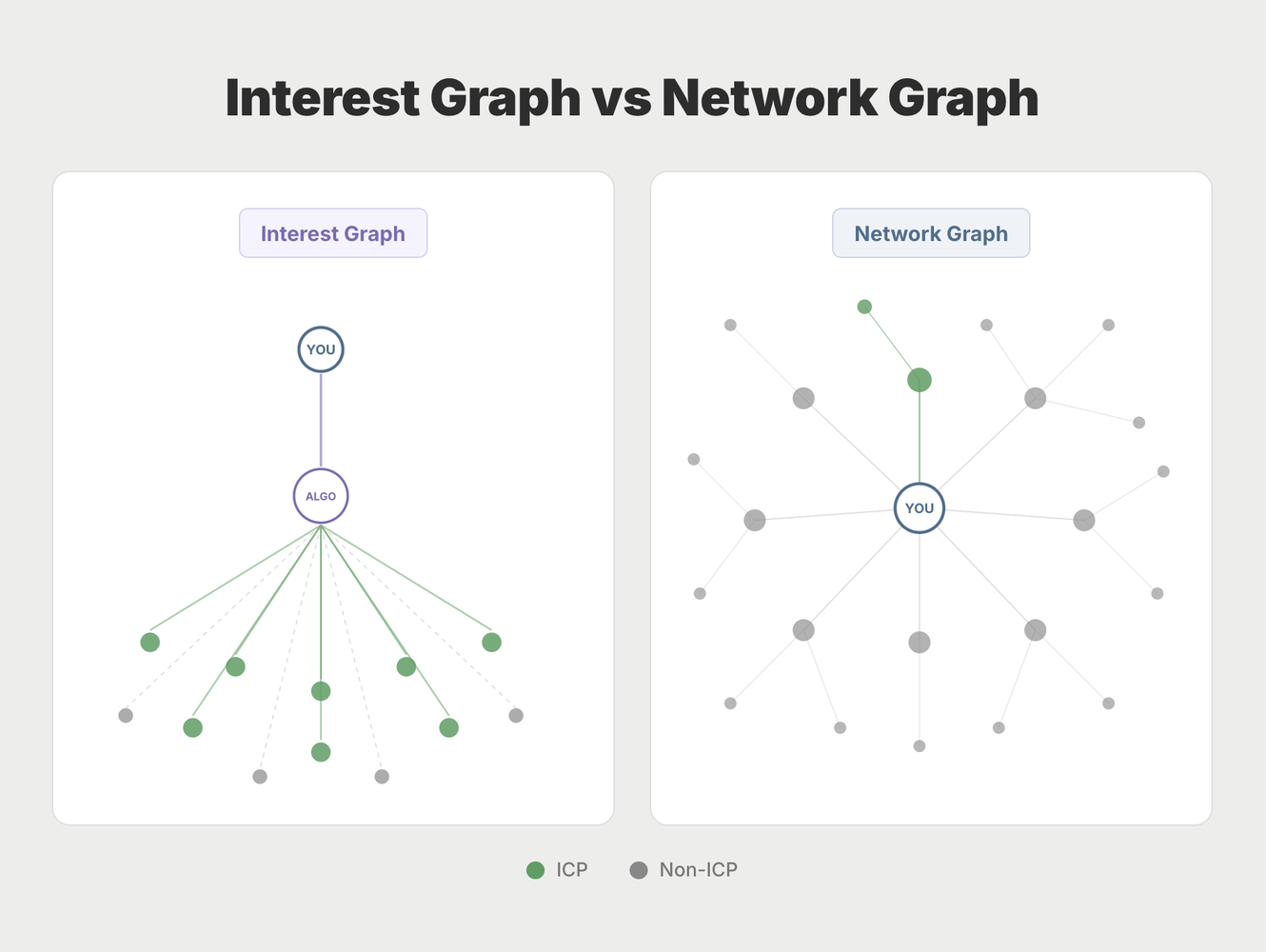
Network-based algorithms rely primarily on your connections to distribute content. If someone in your network publishes a post, you will see it. If someone in your network likes a post, you will see it. And so on.
It's important to know that network-based algorithms are not the norm. In fact, the vast majority of social platforms that likely dominate your screen time (TikTok, Instagram, X, Threads, YouTube) are all primarily interest-based.
Interest-based algorithms rely primarily on a graph of your assumed interests to distribute content the algorithm thinks you'll like. If you post about a topic, the platform does its best to surface that post to people interested in that topic.
Each platform may have some part of their feed that is network-based, like the "Following" feed on TikTok. But most users, regardless of platform, still interact primarily through the interest-based feed because the content discovery experience is orders of magnitude better. Facebook and Instagram are the only major platforms that still lean heavily network-based, and even there the rise of short form video feeds has pushed them further into the interest-based world.
And then there's LinkedIn. Weird, little LinkedIn.
On LinkedIn, if you publish a post titled "How CFOs should be thinking about the future of AI operations in light of Agentic AI," that post is not going to be shown automatically to CFOs. Instead, it will be shown to a small subset of your connections and followers, which likely includes:
- Former bosses and colleagues
- Coworkers
- College roommates
- Your cousin Gilroy and uncle Sylvester
- Possibly one or two people in and around the world of finance (if you're lucky)
If and when those people engage with your post, LinkedIn will then show your post to a larger subset of your connections and followers, in addition to the connections and followers of those who engaged. And so on. This is the most straightforward way to understand LinkedIn's network-based algorithm.
There are complexities around who lands in that first group, what happens when you tag someone, and so on. But the most that anyone really needs to understand for basic LinkedIn content strategy is that content moves from person to person and is not, no matter how much you kick and scream, algorithmically pushed to users based on their demographics, firmographics, inclinations, and interests.
Said once again, more plainly: LinkedIn is not going to show every CFO interested in AI operations the aforementioned post. I wish that was how LinkedIn worked. It doesn't.
So when executives complain that their content isn't going anywhere, it's almost always because that content is simply not reaching their ICP. You can't even begin to measure the efficacy of the content because the distribution is out of sync with the intended audience.
Don't believe me? Scroll through your feed and tell me how much of the content you see is from a first degree connection, either their own post or a post they engaged with.
For as long as you continue to assume that LinkedIn functions like every other social platform you use, you will be terribly frustrated at the impact you're able to create here.
(Note: the only exception is a very limited number of "suggested content" placements on the feed as well as LinkedIn's video feed. Even these placements, which represent a very small portion of overall impression share, are only very broadly interest graphed. The vast majority of your content is going to live and die by your network.)
The answer you don't want to hear
So then, we're all left to wonder: how on Earth can I get in front of my ICP if I don't already have tens of thousands of ICP connections and followers?
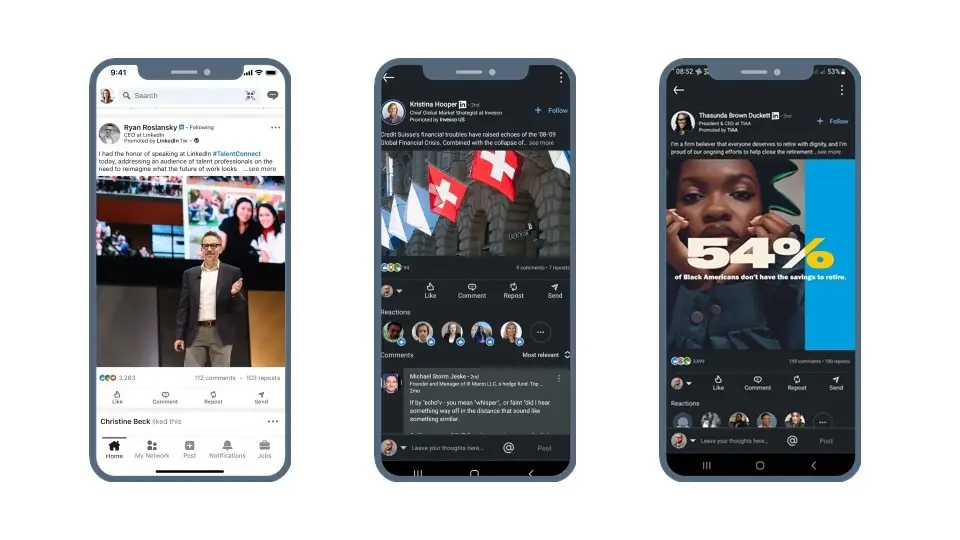
That's a great question, and the most straightforward answer is to pay LinkedIn advertising dollars to put that content in front of your ICP using Thought Leader Ads (TLAs) or Boosted Posts. In other words: pay to play.
While that's a somewhat uninspiring conclusion, it's also relatively straightforward when you consider all the madness that growth purely through organic requires. A company can (and in my view, should) spend money to circumvent the algorithm and show their content to their ICP directly.
If you want to see the paid plus organic model executed at full scale, read how Vibe.co took over LinkedIn on the way to a $1.4B acquisition.
Unfortunately, not all companies are going to do this, mostly due to an incurable allergy to spending money on any marketing that isn't explicitly lower funnel. This is ironic when you consider that most companies have already spent years and countless dollars attempting to win on LinkedIn, only to produce organic content that is extraordinarily under-leveraged through the organic feed.
I digress. The business world does not always operate as rationally as one would hope.
So you want to make this work organically
No ad dollars available. Got it. Now what?
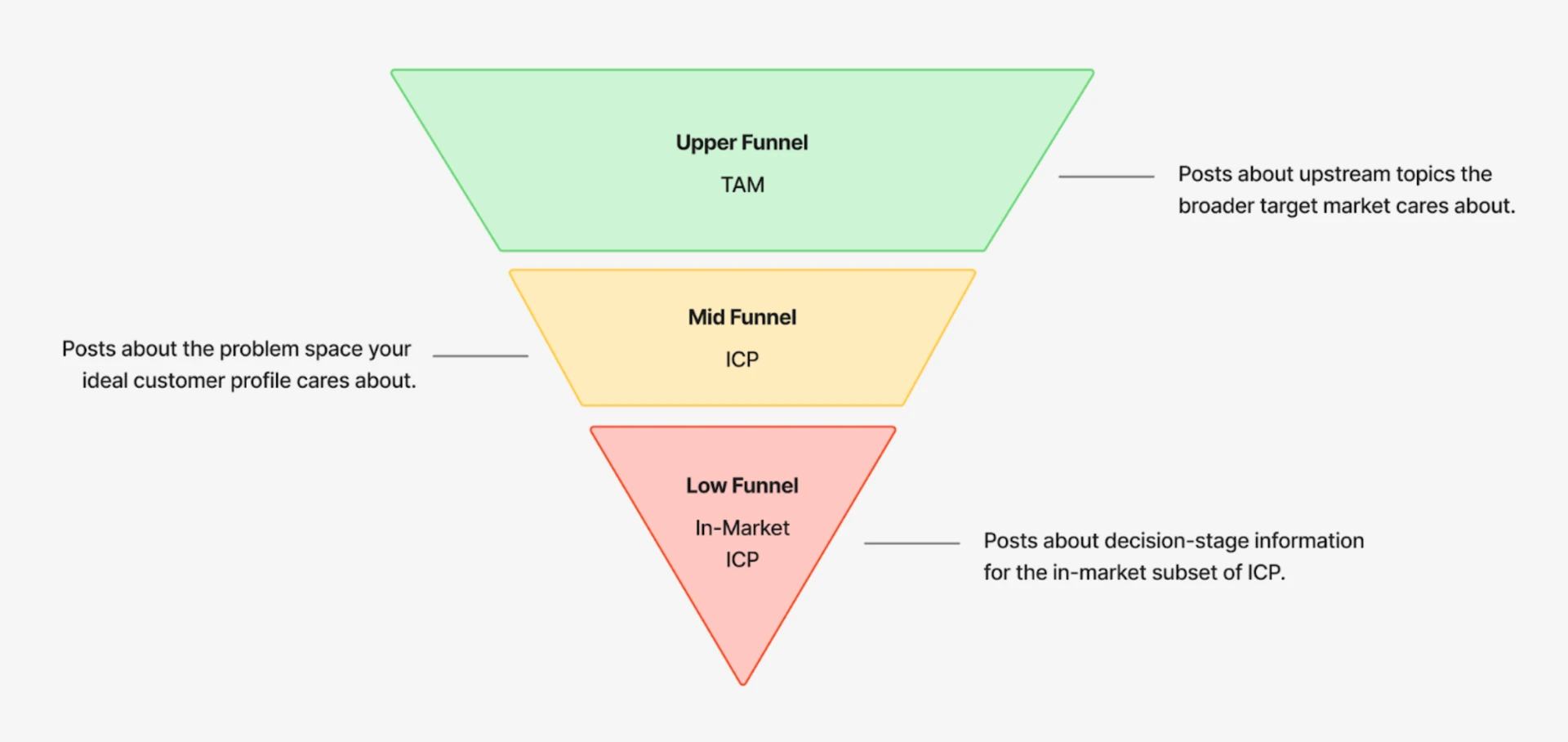
In order to build an organic strategy that can effectively attract new ICP engagement and followers, we must first consider how content funnel stages interact with this network-based algorithm. At Influent, we classify content into funnel stages that correspond to the intended audience layer plus the buying-state of the reader. These distinctions matter for what comes next:
- Upper Funnel (TAM): Content that addresses broad industry topics, trends, or challenges the total addressable market cares about. The goal is reach and thought leadership by joining relevant conversations. It positions the company or executive as knowledgeable, but doesn't directly address specific customer problems or push toward conversion.
- Mid Funnel (ICP): Content focused on the specific problems and pain points the ideal customer profile experiences. The goal is to build urgency and make the reader recognize they have a problem worth solving. It quantifies the cost of inaction and frames the problem as strategic rather than operational. It rarely mentions specific solutions or products.
- Low Funnel (In-Market ICP): Content that teaches how to solve the problem through methodologies, implementation approaches, or tactical frameworks. The goal is to educate in-market buyers on what good solutions look like and how to evaluate options. It may present your product as one solution, but primarily de-risks the decision and shapes buying criteria.
Where the network graph and the funnel collide
As established, your existing network is a mixed population: former colleagues, industry peers, professional acquaintances, and somewhere in there, a small portion of your actual ICP.
But even among your ICP connections and followers, in-depth research (including research conducted by LinkedIn themselves) consistently shows that only 3 to 5% of any market is actively in buying mode at a given time. In-market buyers are a tiny fraction of your ICP, which is itself a fraction of your total network.
Low funnel content is written exclusively for that final fraction. Which means when you publish it, the vast majority of your network has no reason to engage. Low engagement means low distribution. Low distribution means no new followers. And without new followers, that fraction stays small or shrinks.
Executives who start here often struggle and interpret their lack of results as a content quality problem, not a distribution problem. So they keep rewriting the same low funnel posts until they get mad, claim they are shadow-banned, and quit.
Upper funnel content totally inverts this. When you write about broad industry topics relevant to your entire TAM, engagement comes from a much larger share of your existing network. Those engagements trigger distribution into their networks, populated by their peers, who are also likely in your TAM.
Your follower base grows, and it grows with the right people. Because each new TAM follower expands the network your future content distributes into, this effect compounds. The base accelerates rather than grows linearly.
Mid funnel content then does the filtering. Content that precisely names the problems your ICP is living with will resonate disproportionately with ICP-profile readers. They engage, they follow, and their networks skew similarly. Over time, the concentration of ICP followers within your audience increases.
By the time you deploy low funnel content, the audience it requires actually exists. The in-market buyers are there, because you built the base systematically, from the outside in.
Beware the upper funnel vanity metric trap
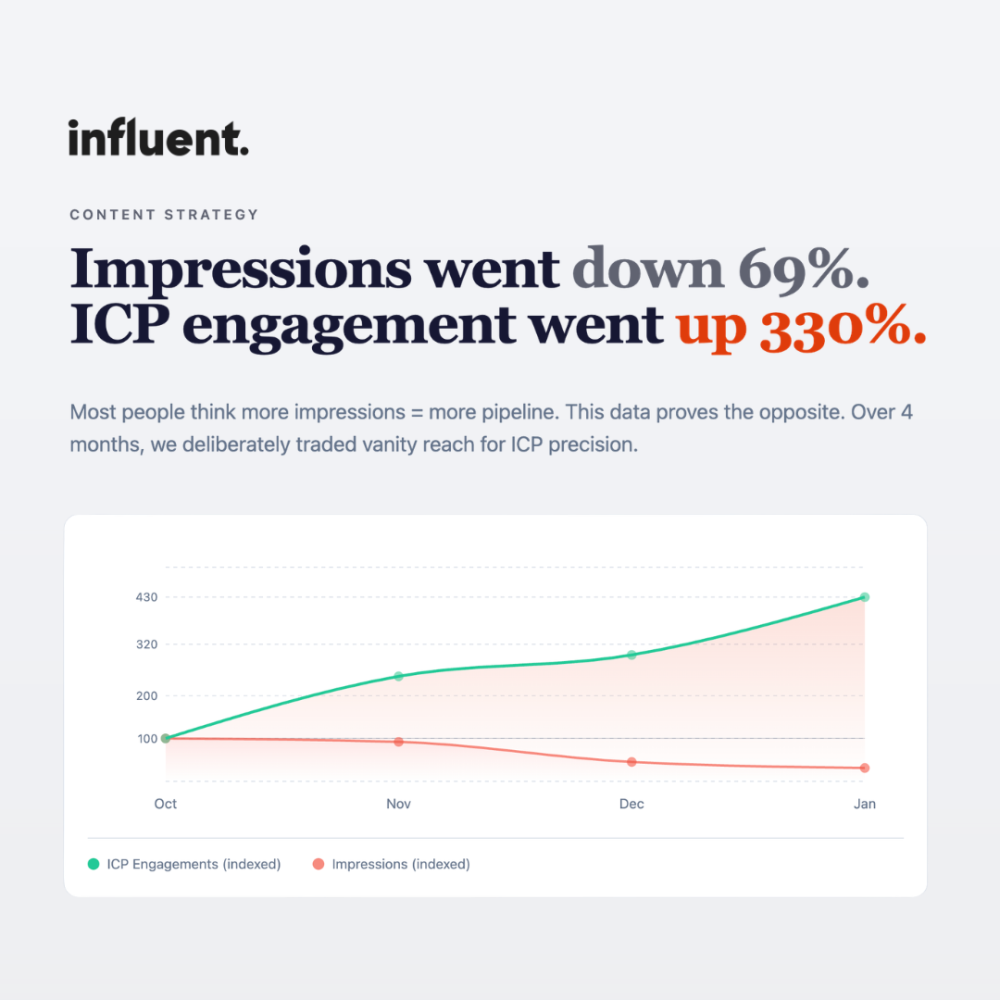
There is some compounding irony built into this model that is worth pointing out. Upper funnel content, by design, reaches the broadest audience, which means it generates the most impressions, the most likes, and the fastest follower growth. Every metric that LinkedIn surfaces prominently will tell you it's working.
This creates a powerful incentive to stay there, one that is entirely rational given the feedback the platform provides, and entirely counterproductive given the actual goal. Executives post upper funnel content, see the numbers climb, and keep posting upper funnel content. Their audience grows. Their impressions grow. And they never understand why none of it produces pipeline.
The same trap exists at the extreme end of upper funnel, which I call personal branding content (posts about leadership philosophy, career milestones, and professional identity). These often generate the highest engagement of all. But they're also the furthest removed from any commercial outcome.
Upper funnel content alone can build credibility, social proof, and broad market visibility. But if the goal is pipeline, target account pressure, or measurable ICP engagement (ICPE), upper funnel content alone will not get you there. This is why mid and low funnel content must be layered in deliberately, even when the metrics make it uncomfortable.
Mid and low funnel posts will almost always underperform upper funnel posts on vanity metrics. That is expected and by design. They are reaching a smaller, more qualified subset of your audience. The measure of their success is not impressions. It is ICP engagement rate, which is the strongest directly measurable correlate to lead flow and target account pressure available on the platform.
Designing the strategy
Given all of this, the first question to ask when designing a content strategy is not "what should we write about?" but "what does our current network look like?" That answer dictates the content distribution.
Marketing leaders who reorganize around this distribution reality tend to share a specific set of habits, which I break down in The LinkedIn-First CMO.
When in-market ICP density is low, the strategy should weight heavily toward upper funnel content to grow the TAM base, layer in a moderate amount of mid funnel content to begin filtering ICP followers out of that growing base, and introduce low funnel content sparingly to serve the in-market buyers who do exist while beginning to shape buying criteria for those who aren't there yet.
As the overall audience grows and ICP density increases, those levers need to adjust. The strategy is not static. It responds to the composition of the network as it develops.
The end part
You made it to the end. As your reward, here's a single paragraph you could have read instead of everything above:
Every other platform rewards great content with distribution. LinkedIn rewards great networks with reach. Until you internalize that distinction, you will keep producing content that deserves to work and wondering why it doesn't.
Adjacent reading: if you are weighing outside help to fix the distribution half of this, start with the best LinkedIn marketing agencies in 2026 and what a program costs.
Questions
Frequently asked questions
- Is the LinkedIn algorithm interest-based like TikTok?
- No. LinkedIn is network-based. It distributes a post outward through the author's connections and their connections, rather than matching the post to strangers who care about the topic.
- Why does my LinkedIn content get low reach even when it is good?
- Because reach is limited by the author's network, not by content quality. If your buyers are not in or adjacent to your connection graph, they will not see the post no matter how well it is written.
- How do you get LinkedIn content in front of target accounts?
- Use Thought Leader Ads or Boosted Posts to place organic executive content directly in front of a targeted account list, and grow the executive's network toward that same audience over time.
A weekly newsletter is coming
Garret’s original thinking on attention, credibility and distribution. Email signup is being updated.
About the newsletterWork with us
Ready to dominate LinkedIn?
Influent builds and runs executive LinkedIn programs for category-leading B2B companies.