July 14, 2026 · 11 min read
Vibe.co's LinkedIn strategy: the $1.4B acquisition playbook
Walmart acquired Vibe.co for a reported $1.4 billion. A breakdown of the three-part LinkedIn motion behind the run, pulled entirely from public data.
Garret Caudle, Founder, Influent

Short answer
Vibe.co's run to a reported $1.4 billion Walmart exit was backed by a three-part LinkedIn motion: a founder publishing a sharp category point of view, paid amplification of the best posts, and direct sales follow-up on engagement.
Key takeaways
- Vibe.co's four most active executives have roughly 120% of the company page's follower count. Competitors sit between 9% and 36%.
- Each executive is mapped to a different seat on the buying committee and posts for their own peer set.
- Vibe's LinkedIn ad library holds 6,735 ads versus 1,363 for MNTN, the publicly traded category leader.
- Paid budget only goes behind executive posts that already performed organically.
- Company news is announced through five executive profiles at once, then amplified, so one announcement feels like industry consensus.
- Partnerships and investor relationships are run as campaigns into the partner's audience, not one-off posts.
Walmart just acquired Vibe.co for a reported $1.4 billion.
Vibe.co sells connected TV advertising to SMBs in a category full of older, bigger, much better-funded competitors, and they still reached $250M ARR and a 10-figure exit in about four years.
The results, in short: four executives grew 34,052 followers between them, about 120% of the company page's 28,370. Vibe ran 6,735 ads in the LinkedIn ad library, roughly 5x MNTN and 14x Tatari. Their CEO's version of a funding announcement out-performed the company page's by 3x (1,056 reactions vs 346). Once attribution was fixed, LinkedIn returned more than a dollar for every dollar spent, and the budget grew.
Plenty of people have written about their subway ads, their out-of-home spend, and their CTV campaigns. Almost nobody has written about what they did on LinkedIn, which is where I think the most transferable lessons live.
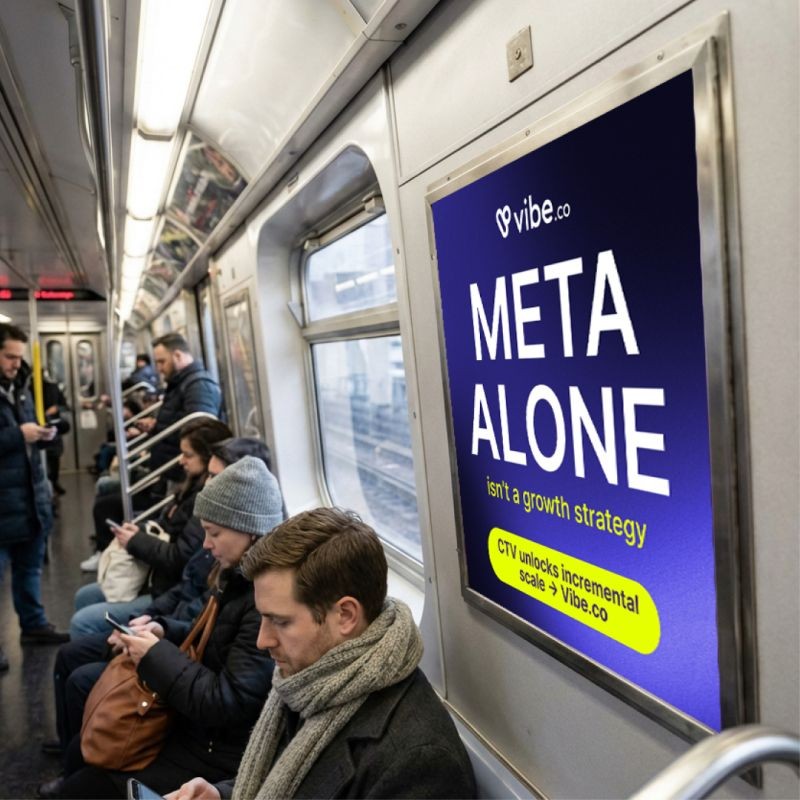
On July 10, 2026, I pulled their entire public LinkedIn footprint: the ad library, every executive's post history, the company page, and the same data for their three closest competitors (MNTN, Tatari, and tvScientific). Everything below comes from those public sources.
The three parts of the strategy
When a company says it is going all in on LinkedIn, it usually means one of two things: a ghostwriter has been hired to turn the CEO into a philosopher, or a lead gen vendor has been hired to spray InMail across the market. Vibe did neither.
Their program breaks into three motions:
- Executive thought leadership. Multiple executives posting, each mapped to a different member of the buying committee, amplified with Thought Leader Ads.
- LinkedIn-native PR. Company news announced through executive profiles rather than the company page, then paid into the target account list.
- LinkedIn-native partnerships. Integrations and investor relationships turned into media moments rather than one-off announcements.
The common thread: organic proves what is worth amplifying, and paid buys the reach organic can never earn on its own.
Part 1: Executive thought leadership
Vibe's company page has 28,370 followers. Their four most active executives total 34,052 between them, roughly 120% of the company page.
- Arthur Querou, CEO: 17,167 followers
- Senda Ben Abdallah, Director of Brand and Product Marketing: 7,754 followers
- Romain Marsal, VP Growth and Marketing: 5,154 followers
- Quentin Marchese, CRO: 3,977 followers
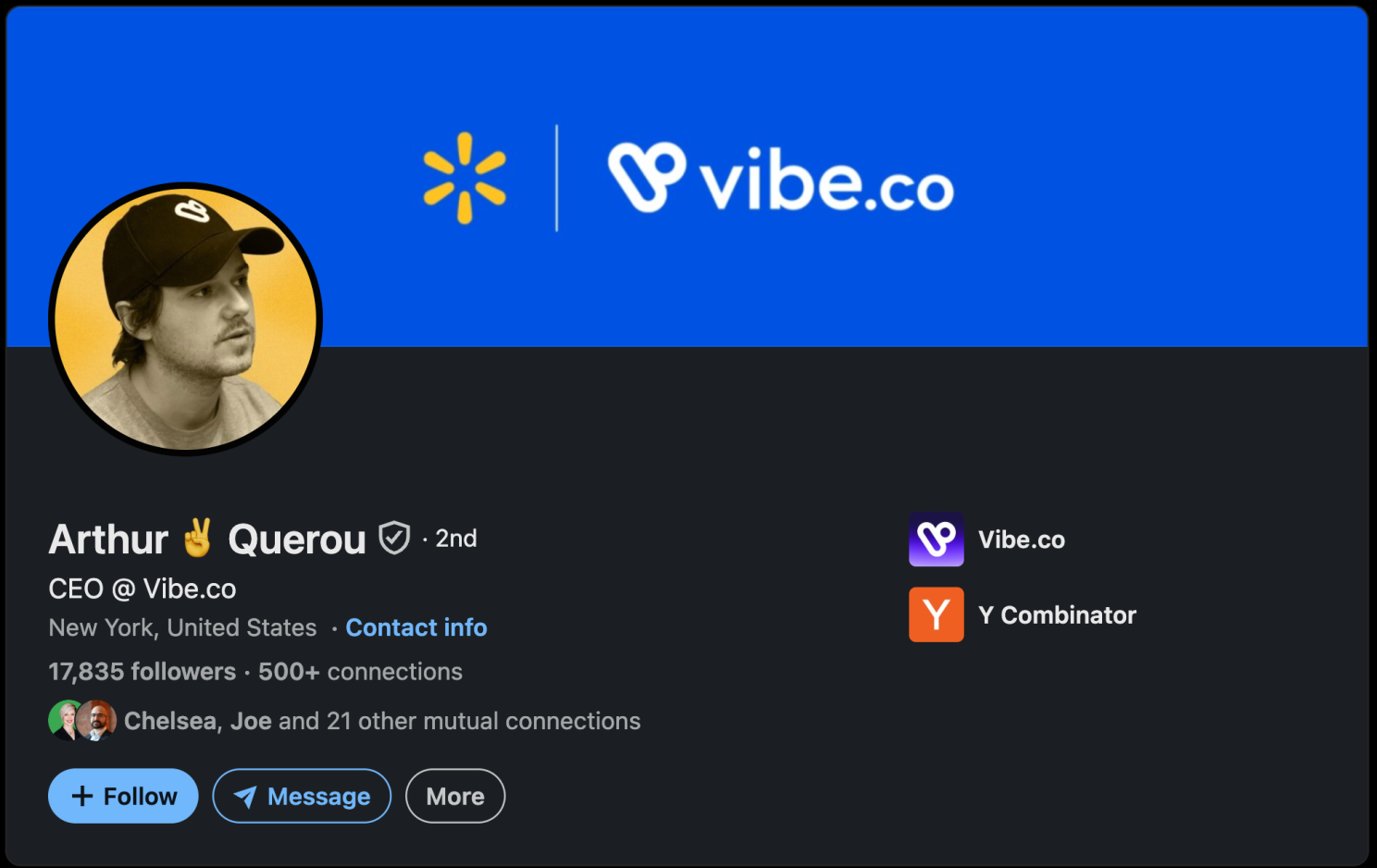
Nobody else in the category is close. Measured against their own company pages, executives at Tatari sit at 36%, tvScientific at 32%, and MNTN at 9%.
Coverage of the buying committee
A decision to spend on CTV advertising typically has to clear four people, and Vibe put an executive in front of each one:
Mapping voices to the buying committee is the same fix for the mistake behind the McDonald's CEO backlash. We use a simple three-vector framework for multi-executive LinkedIn strategy to decide which executives to activate and what each one owns.
- The CEO or founder, who wants to know whether the channel works at all. Covered by Arthur, the CEO.
- The C-suite revenue leader, who wants evidence that CTV produces sales. Covered by Quentin, the CRO.
- The marketing VP, who wants to know how it works day to day. Covered by Romain, VP of Growth.
- The marketing director, who wants to see the creative and messaging. Covered by Senda, Director of Brand and Product Marketing.
Each executive posts for their own peer set, which matters for three reasons. They have credibility with those peers. LinkedIn's algorithm is network-based, and each executive is connected to more of their counterparts than anyone else at the company. And LinkedIn weighs whether your profile actually supports the subject you are posting about.
"When someone's profile signals expertise in a specific area and their content reflects that same expertise, credibility matters tremendously in terms of distribution in the feed," LinkedIn's VP of Trust Products, Oscar Rodriguez, has said publicly.
What each of them actually posts
Arthur, the CEO, posts company results, including revenue and growth rate every quarter. Build in public, essentially. It works because growing revenue implies thousands of marketers keep buying CTV, and because revenue curves are intrinsically interesting to other founders.
Romain, the VP of Growth, posts the marketing department's approach and numbers. He published the full $40M 2026 budget as a spreadsheet, and that post drew 451 reactions and 188 comments, more than any product announcement any Vibe executive has ever published. Marketers almost never get to see a peer's real budget, and a marketing engine that visibly works makes the product look credible by association.
Thought Leader Ads carry the reach
Organic posts travel through an executive's existing network, and most of Vibe's future customers are not in those networks. So Vibe pays LinkedIn to place the posts in front of the companies it wants.
This is the network-based distribution ceiling in action, explained in full in everything you know about the LinkedIn algorithm is wrong.
The scale gap is the whole story:
| Company | Ads in LinkedIn ad library |
|---|---|
| Vibe.co | 6,735 |
| MNTN | 1,363 |
| Tatari | 481 |
| tvScientific | 364 |
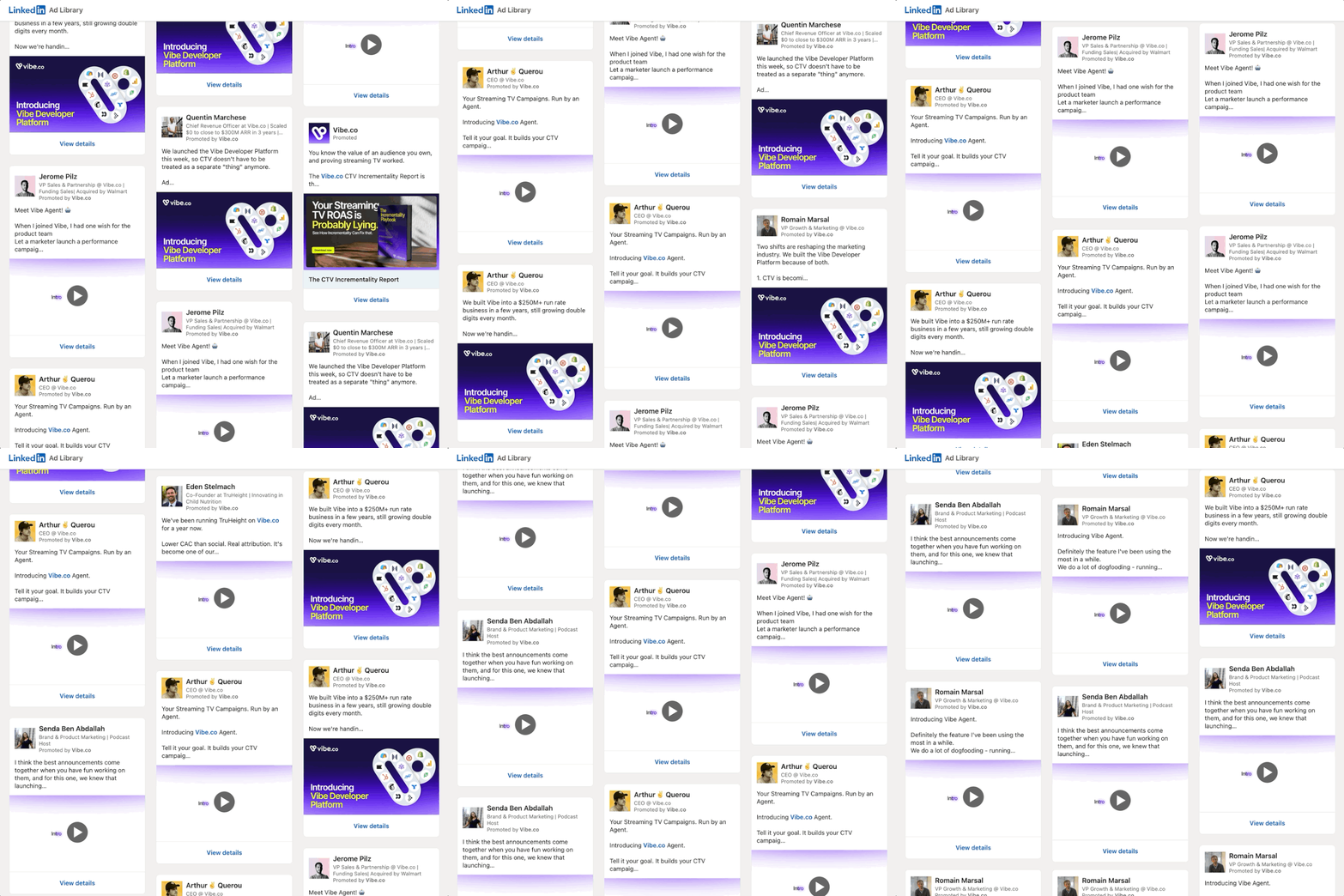
They watch which executive posts perform organically, then put budget behind the ones that have already proven themselves. Untested creative does not get funded.
The ads also run from more than the four core executives. Vibe used 12 or more employees and outside voices, including Jerome Pilz (VP Sales and Partnerships), Alexandre Pham (EVP Enterprise), and outside creators like Nick Shackelford and Martin Galabru. Some of those people barely post organically, which does not matter, because the point is not their followers. The point is that a buyer keeps seeing different faces from the same company.
Targeting and measurement
In an interview with LinkedIn, Romain described the targeting approach: Vibe keeps roughly 100,000 target companies in its CRM with about 30 facts recorded about each one, such as which marketing tools they use and whether they already run ads elsewhere. Those companies are then sorted into groups, and each group sees the message that fits it rather than one generic ad.
Measurement nearly killed the channel. At first they only counted sales that happened right after an ad click, and by that standard LinkedIn looked like it was not working. After they changed the model, LinkedIn turned out to be producing significant business, particularly through brand campaigns and video Thought Leader Ads that were reaching accounts that later became sales conversations. Romain could then show the CFO that every dollar spent returned more than a dollar, and the budget grew.
The company page's real job
Vibe's page posts funding news, product announcements, customer results, and jobs. Its best post ever, the $50M raise, drew 346 reactions. Arthur's post about the same news drew 1,056.
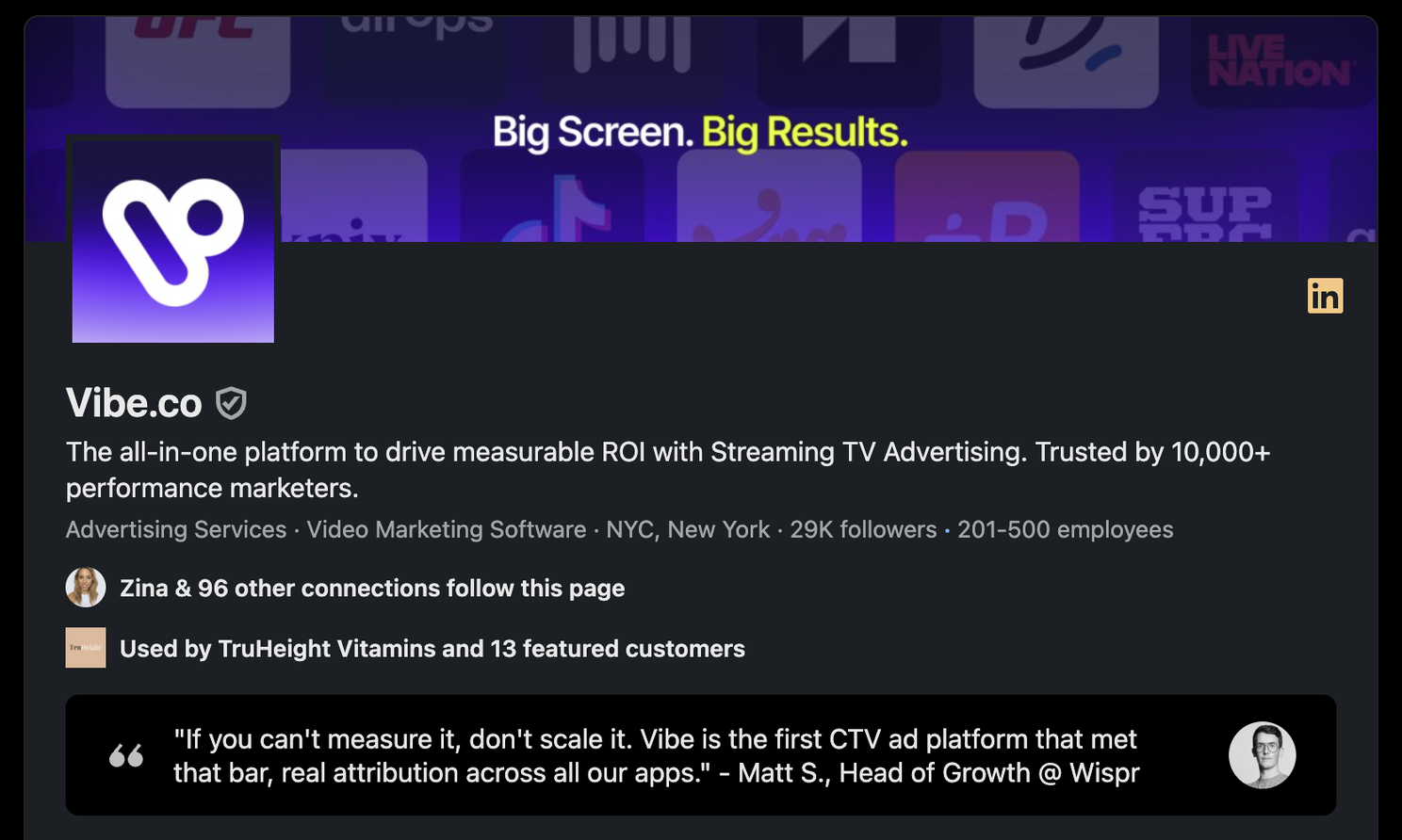
The page is not built for reach. It is built for the buyer who is close to a decision and goes to look the company up, which buyers always do. That person finds the banner, the customer logos, a pinned testimonial, and a record of progress.
Part 2: LinkedIn-native PR
Vibe announces company news through executive profiles and pays to distribute it.
That is the comms model described in The LinkedIn-First comms leader, running at full speed.
When the Walmart acquisition was announced, Arthur posted it on his personal profile and drew 2,653 reactions and 397 comments. His co-founder posted a version. So did the CRO, the VP of Sales, and the EVP of Enterprise. The ad library shows those posts running as paid Thought Leader Ads.
One announcement from a company reads like an announcement. The same news arriving from five different people, repeatedly, reads like the industry talking about it. The buyer cannot miss it, and assumes everyone else is seeing it too, even though every version came from the same company.
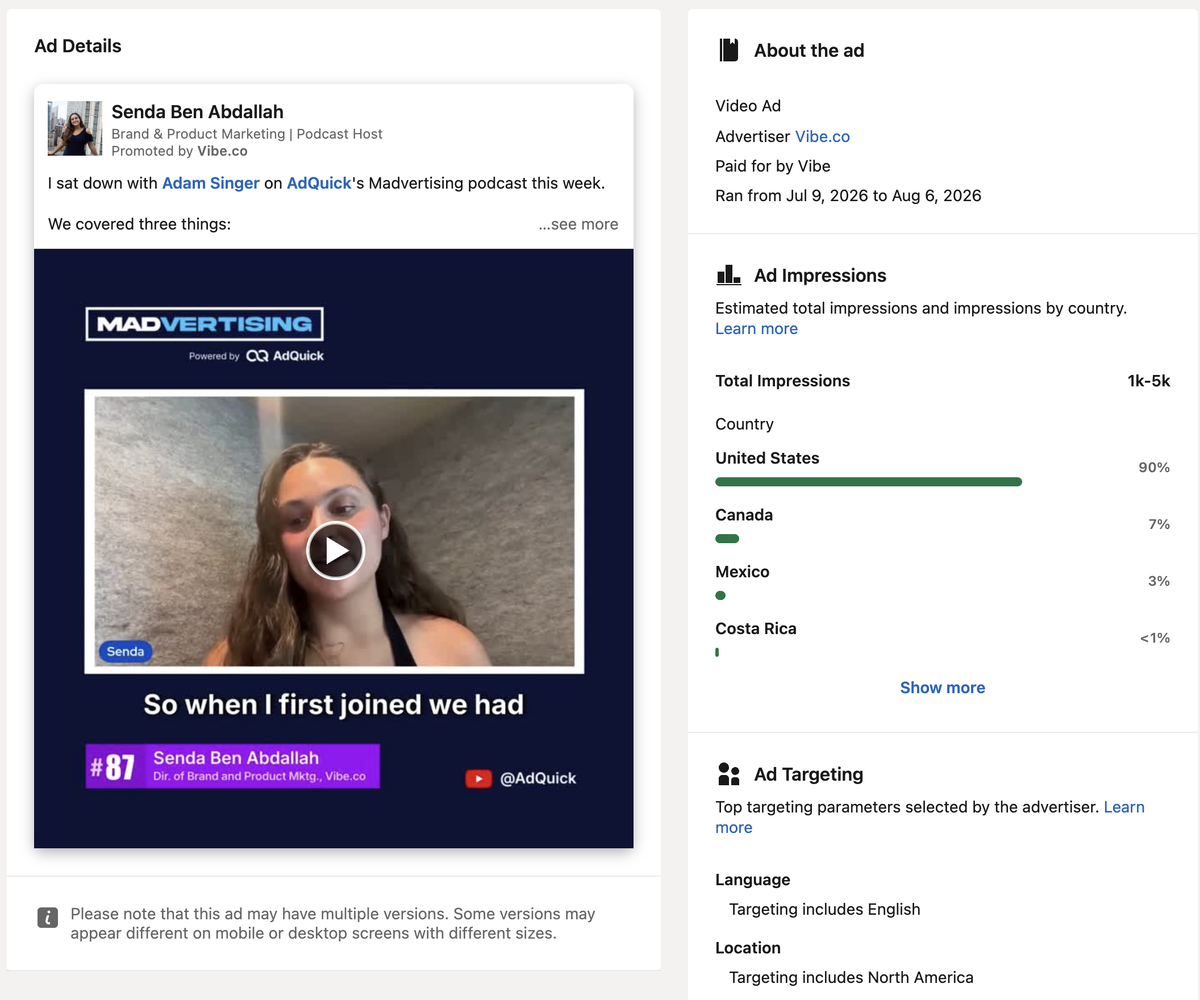
They extend the same logic into podcasts, appearing on shows in the space and then layering Thought Leader Ads on top of the clips to squeeze more reach out of each placement.
Part 3: LinkedIn-native partnerships
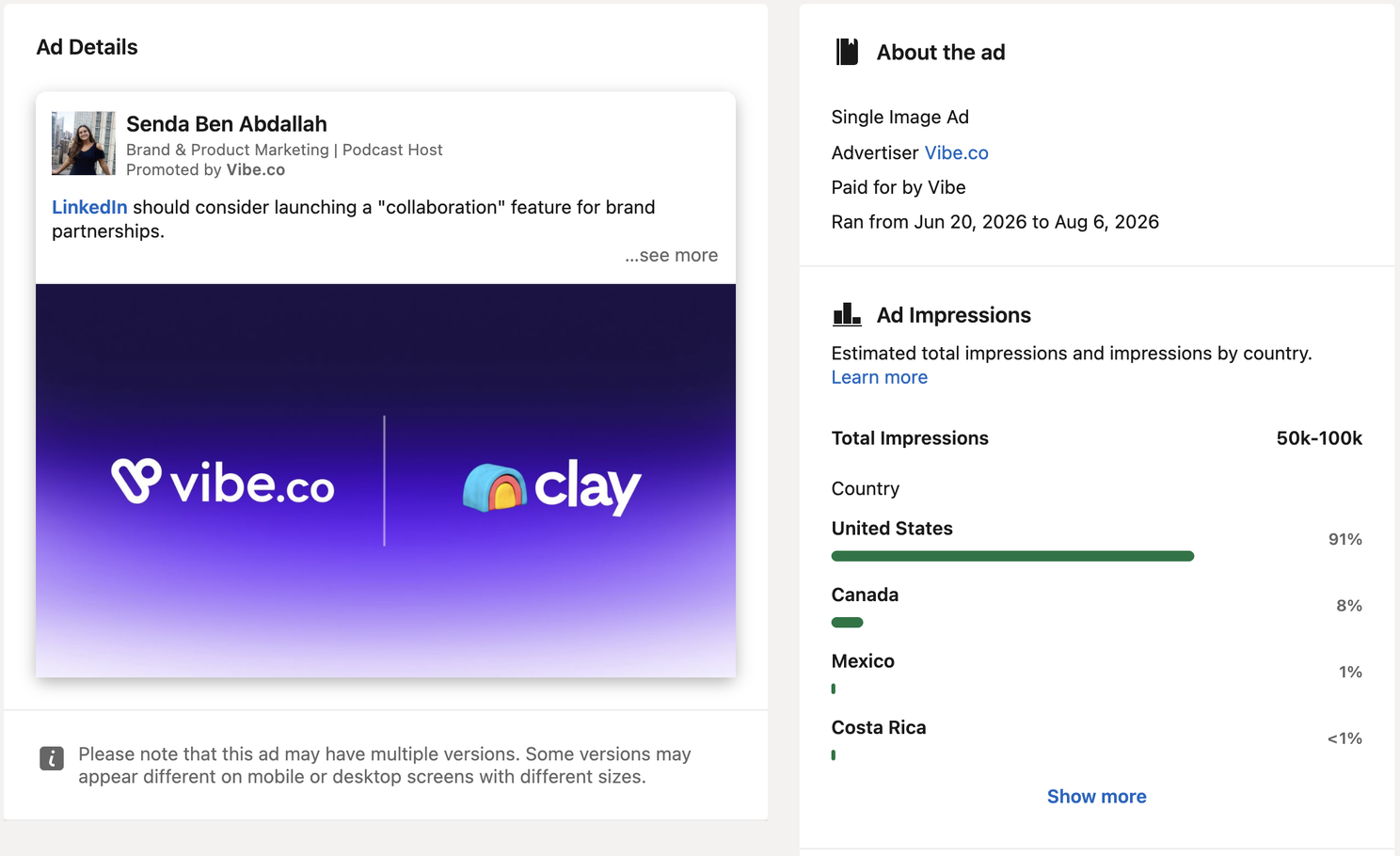
When Vibe integrates with another software company, they treat it as a campaign rather than a one-time announcement. Their Clay integration was, for at least a month, the most-used ad in their library, running in at least three forms: a company ad about retargeting a Clay audience on streaming TV, a sponsored post from Quentin, and a sponsored post from outside creator Martin Galabru.
Everyone using Clay is a marketer who buys software and runs campaigns, which is exactly Vibe's buyer. The same pattern shows up with HubSpot, with analytics partners like Northbeam, and even with investors such as QuantumLight.
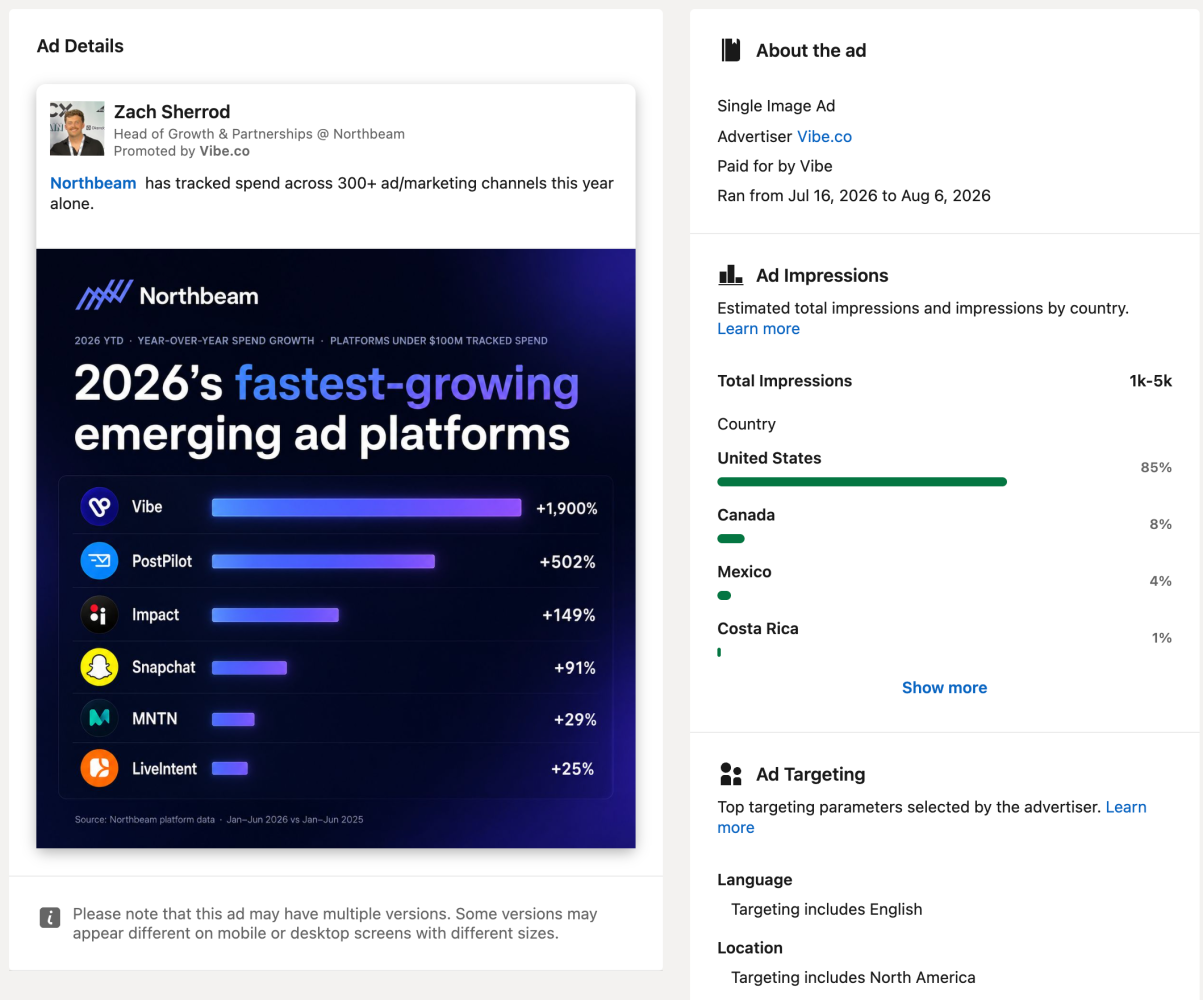
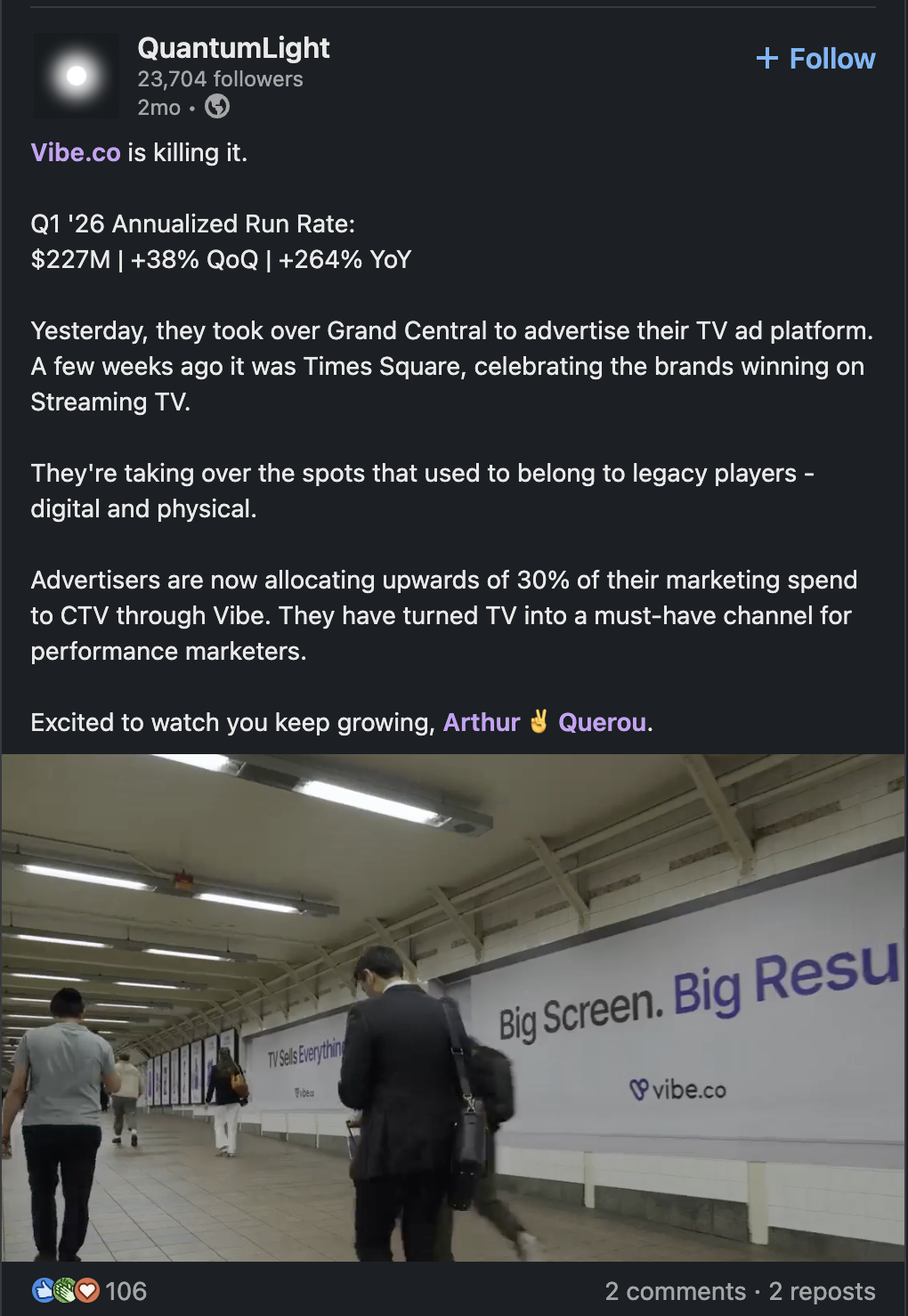
Each partner already has an audience full of the same kind of marketer. An investor endorsement reads as third-party validation rather than a sales pitch. And when vendors start posting about Vibe unprompted, one company's message starts to look like industry consensus.
Part 1 borrows credibility from Vibe's own executives to reach their peers. Part 3 borrows credibility from partners, investors, and vendors to reach the same buyer through someone other than Vibe.
Why running all three together matters
No competitor in the category runs all three. Their founders post, and that is where it stops. MNTN has the largest company page in the category and Ryan Reynolds as Chief Creative Officer, and runs no Thought Leader Ads at all. Every ad in its library comes from the company page.
Each motion makes the next one work better. Executive posts build an audience. A larger audience makes ads cheaper, because the people seeing them already recognize the person. Ads put the posts in front of target companies and partner audiences the executives could never reach alone. Those new people follow the executives, and the next post travels further.
Fund only one piece and you get none of that. A company that hires a ghostwriter for its CEO has exactly one person posting into whatever audience they already had.
How to apply this to your own program
- Compare your executives' combined follower count to your company page's. If the page is far ahead, your reach depends on the asset buyers trust least.
- Map your buying committee and assign an executive to each seat, rather than concentrating everything on the CEO.
- Have each executive post for their own peer set, not for a general audience.
- Put paid budget behind organic posts that have already proven they perform. Do not fund untested creative.
- Announce real company news through multiple executive profiles, not only the company page.
- Turn partnerships into campaigns that reach the partner's audience, not just your own.
- Give partners, investors, and vendors a reason to post about you without being asked.
- Identify the people from target accounts who engage, and follow up while it is still fresh.
Everything here came from a public ad library and public profiles. No leaked deck, no inside source. Your competitors can look at your program the same way, so the only question left is whether they will like what they find.
The one-paragraph version
Most B2B companies treat LinkedIn as a content channel, where good posts are supposed to travel on their own. Vibe treated it as a distribution system, where organic proves what deserves amplification and paid buys the reach organic could never earn by itself. Until you internalize that distinction, you will keep producing content that deserves to work and wondering why it does not.
Adjacent reading: the best LinkedIn marketing agencies in 2026 if you want this motion run for you, and agency vs in-house vs freelancer if you are deciding how to staff it.
Questions
Frequently asked questions
- What was Vibe.co's LinkedIn strategy?
- Three motions running together: multi-executive thought leadership mapped to each seat on the buying committee, LinkedIn-native PR where company news is announced through executive profiles instead of the company page, and partnership campaigns that put Vibe in front of partner and investor audiences. All three are amplified with LinkedIn Thought Leader Ads.
- Why did Vibe.co post company news from executives instead of the company page?
- Reach and credibility. Vibe's best-ever company page post, the $50M funding announcement, drew 346 reactions, while the CEO's post about the same news drew 1,056 and his acquisition post drew 2,653. Publishing the same news through five executives and paying to amplify each version makes an announcement feel like the industry discussing it rather than a company promoting itself.
- What are LinkedIn Thought Leader Ads and how did Vibe.co use them?
- Thought Leader Ads let a company sponsor a post published by an individual rather than by the company page. Vibe ran 6,735 ads, far more than MNTN (1,363), Tatari (481), or tvScientific (364), and only funded posts that had already performed organically. They also ran ads through 12 or more employees and outside creators to create the impression of being everywhere on the platform.
- How did Vibe.co measure LinkedIn performance?
- Initially they counted only sales that followed directly from an ad click, which made LinkedIn look ineffective and nearly ended the investment. After changing the attribution model, they found LinkedIn was driving significant business, especially through brand campaigns and video Thought Leader Ads, which justified a larger budget.
- Can a smaller B2B company copy this playbook?
- Yes, at smaller scale. The structural pieces do not require Vibe's budget: mapping executives to the buying committee, having each one post for their own peer set, announcing news through multiple profiles, amplifying only proven posts, and turning partnerships into campaigns. The ad spend determines speed, not whether the model works.
A weekly newsletter is coming
Garret’s original thinking on attention, credibility and distribution. Email signup is being updated.
About the newsletterWork with us
Ready to dominate LinkedIn?
Influent builds and runs executive LinkedIn programs for category-leading B2B companies.