May 28, 2026 · 8 min read
Why CEO thought leadership backfires: the McDonald's lesson
Picking the CEO as the default thought leader despite an obvious audience-fit problem is the most common reason executive content fails.
Garret Caudle, Founder, Influent

Short answer
Executive content backfires when the wrong person carries the message. Picking the CEO by default, rather than the leader whose expertise fits the audience, is the most common reason a program produces backlash instead of credibility.
Key takeaways
- Content-market fit sits at the intersection of executive depth, audience priorities, and commercial outcome.
- The CEO is not automatically the right voice for every audience.
- Misaligned executive content earns vanity engagement from the wrong people.
- Multi-voice programs unlock content categories a single CEO account could never credibly cover.
- Match each executive to the audience where their perspective actually carries weight.
The McDonald's CEO video and subsequent backlash is an embarrassingly public version of a mistake I see B2B companies make constantly: picking the CEO (or founder) to be the default thought leader despite an obvious audience-fit problem.
This comes from a fundamental misunderstanding of the executive influencer trend as simply "our CEO posts content." When you get to a massive scale like McDonald's, the repercussions of making this mistake are massive. If you're a B2B exec it won't look this dramatic, but it will mean your content is ineffective at best, and majorly damaging to your brand at worst.
"The CEO posting is not the issue. The lack of audience alignment is."
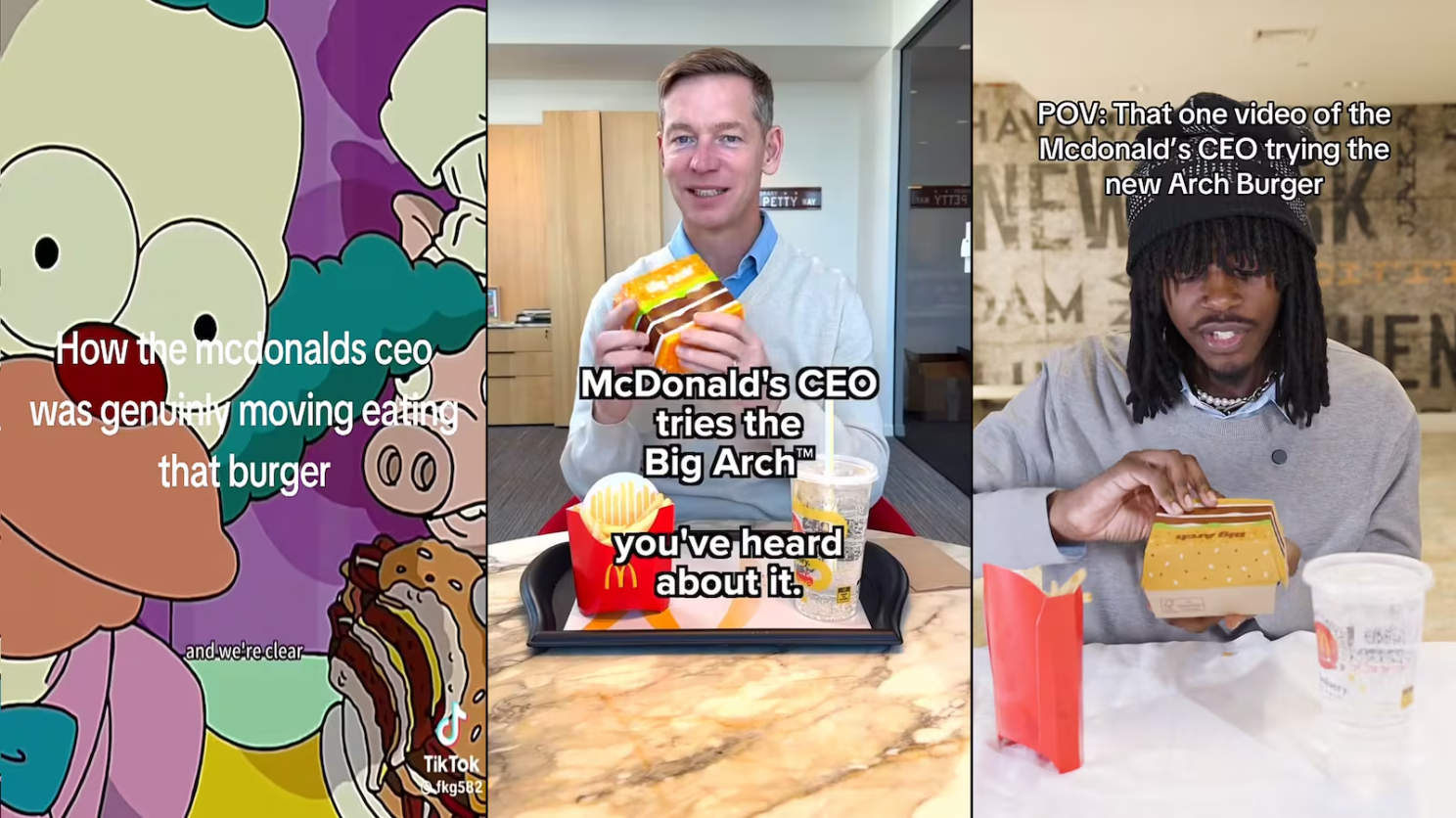
Here's the mental model you need to avoid the mistake, and a suggestion for a better way forward.
The framework: content-market fit
There's a concept we use at Influent called content-market fit. It sits at the intersection of three things: what the executive can speak to with real depth, what the target audience actually cares about in their day-to-day life, and what connects back to a commercial outcome.
If any one of those three is missing, the content either gets ignored, gets vanity engagement from the wrong people, or gets attention and never converts.
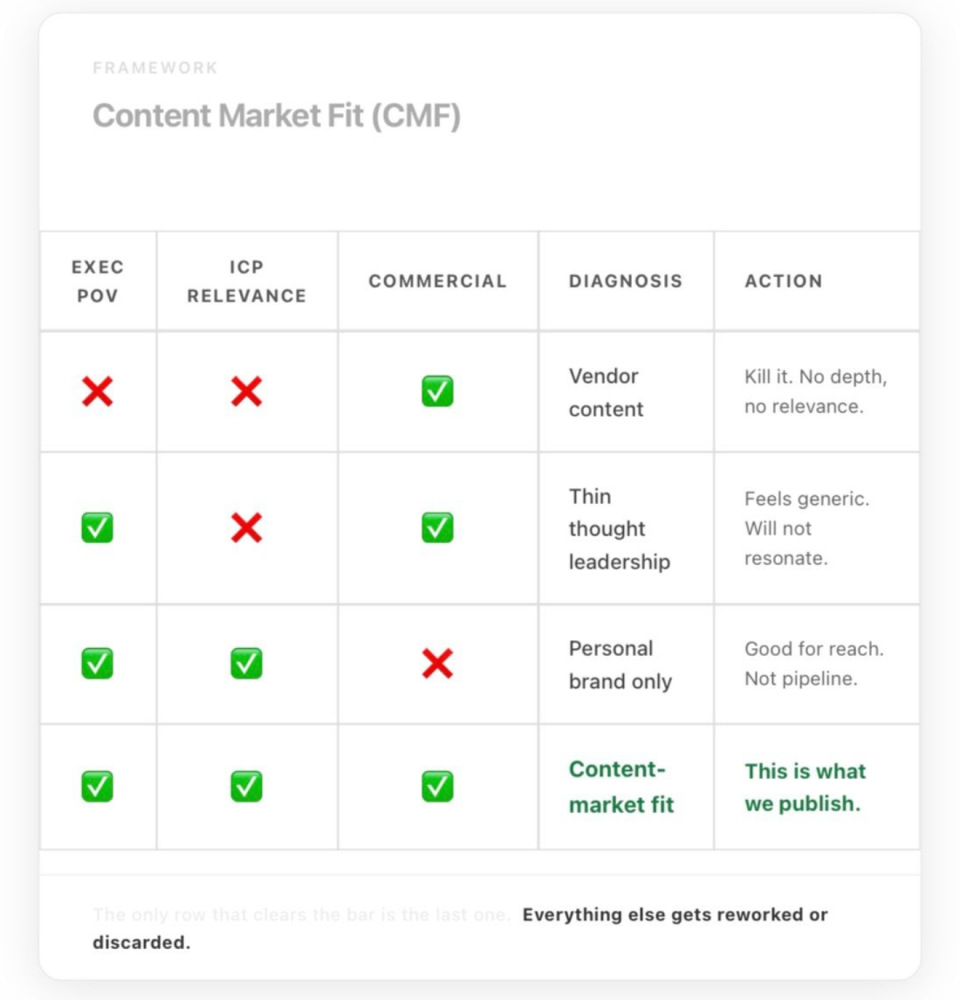
The McDonald's video failed on the first and second checks:
- The CEO does not have an interesting perspective on the burger.
- Consumers do not care what the CEO of McDonald's thinks about the new burger.
That is not information that affects their decision to buy a Big Arch. And the moment he called it a "product" instead of food (which, to be fair, is probably what every executive at that level calls it internally), the distance between his world and the consumer's world was all anyone could see.
Same CEO, different audience, different outcome
That same CEO, talking about that same sandwich, to a different audience, could honestly have been the right move:
- Kempczinski on LinkedIn talking to franchise owners about what the Big Arch means for average ticket size.
- Speaking to investors about how this is their first permanent global menu addition since Chicken McNuggets in 1983 and what that signals about their product roadmap.
- Addressing supply chain partners about how they scaled a half-pound burger across 13,000+ U.S. locations.
He is deeply credible on all of those topics. He passes all three checks. The CEO posting isn't inherently an issue. It's the lack of audience alignment that makes this go off the rails.
The B2B version of this mistake
I see this exact mistake constantly with B2B tech companies. A CEO who is a commercial operator gets positioned as the thought leader for a deeply technical product, and the content falls flat with the engineering audience they're trying to reach. Or the reverse: a technical founder gets positioned to speak to the buying committee three levels above the end user, and the content reads like a product spec when it should read like a business case.
The mismatch between the person, the topic, and the audience is the single most common reason executive LinkedIn content doesn't drive pipeline.
The second most common reason is distribution: LinkedIn reaches your network, not everyone interested in your topic.
This problem has an obvious solution when companies think about it in the context of external influencer partnerships. In B2C, you pair the creator to the audience. A fitness brand doesn't send the CFO to promote protein bars on TikTok. They find someone whose audience equals the buyer. The matching is intuitive and nobody questions it. When companies turn inward and think about their own executives as thought leaders, the matching disappears. CEO equals thought leader. That's the default assumption, and it's almost always wrong at scale.
The multi-voice model
The better model is a multi-voice approach, and very few companies are doing it well.
The obvious benefit of using multiple thought leaders is more flexibility with audience matching, because different people can speak to different segments. The less obvious benefit (and the more exciting one, in my opinion) is that each voice unlocks content territories that literally do not exist for the other voices:
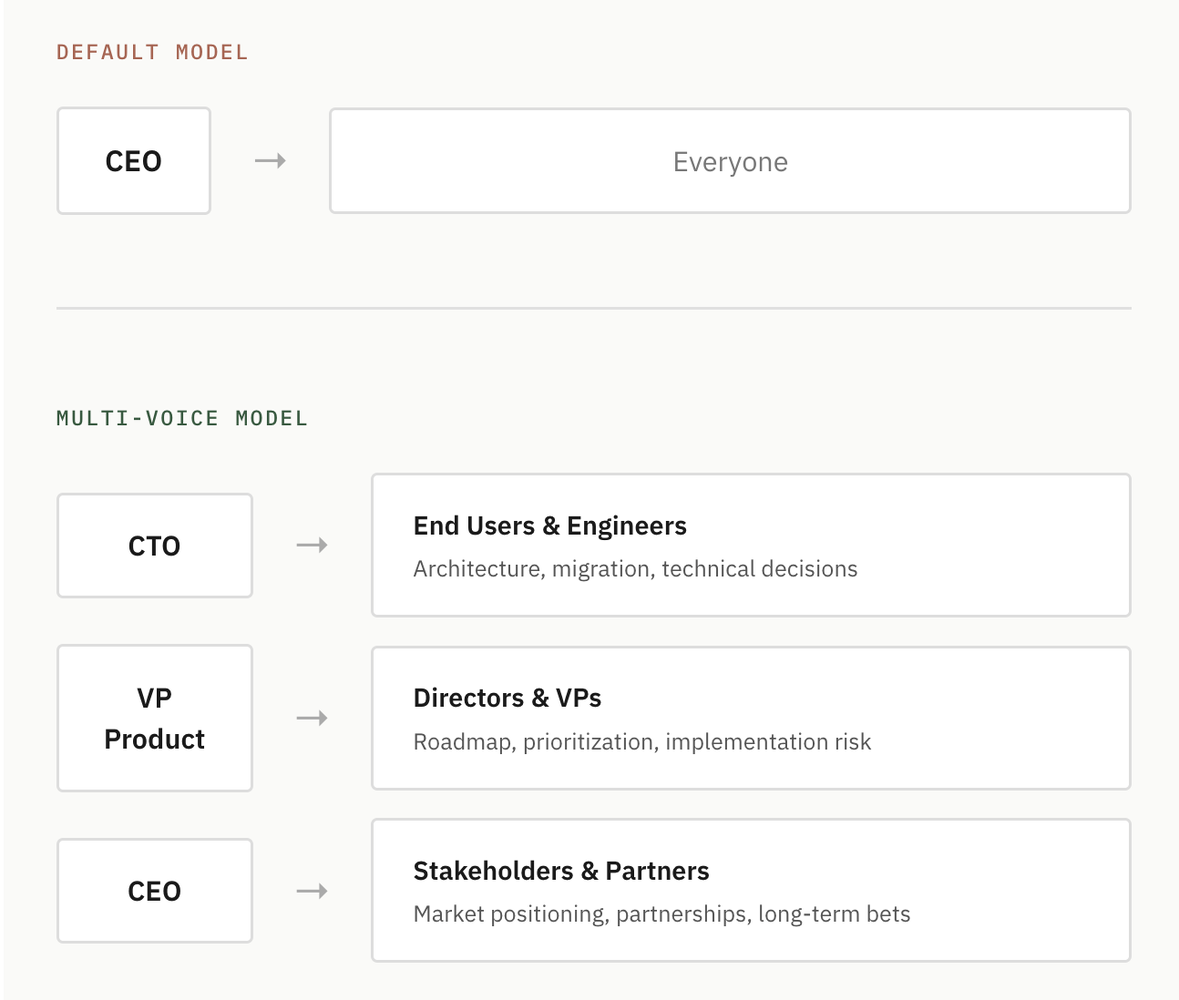
- A CTO can get into architectural tradeoffs, migration complexity, and the real reasons a technical decision was made. That content cannot come from the CEO. The CEO saying it would feel performative, and the audience would know immediately.
- A VP of Product can speak to roadmap philosophy, prioritization frameworks, and how customer feedback actually gets weighted.
- The CEO can speak to market positioning, partnership strategy, and the long-term bet the company is making and why.
These are entirely different bodies of content that only become possible when you put the right person behind them.
This maps directly to how B2B buying actually works. You are not selling to one person. A typical B2B deal involves 4 to 6 stakeholders, and each of them is evaluating the purchase through a completely different lens. The end user cares about whether the product actually works day to day. Their manager cares about implementation risk and team adoption. The VP cares about strategic alignment and ROI. The CFO cares about total cost of ownership and contract terms.
A single executive voice, no matter how good, has content-market fit with maybe one of those people. The rest scroll past.
When you map voices to the buying committee, the content strategy stops being "how do we get our CEO more reach" and becomes "how do we make sure every person involved in this purchase decision encounters a credible voice from our company speaking directly to their concerns."
In the McDonald's case, this could look like a 12-person content operation. Someone from R&D talking about the 50 iterations they tested before landing on the Big Arch sauce (that person would have taken a real bite, by the way). A franchise operator talking about what launch day looks like operationally. A supply chain leader talking about sourcing a new SKU at that scale. And the CEO talking to shareholders, franchise owners, and the press, which are the audiences where his perspective actually carries weight.
We build this for B2B clients. The engineer speaks to the technical end user. A VP of Product speaks to leadership. The CEO speaks to stakeholders and partners. Each voice has content-market fit with their specific audience, and each voice unlocks entire categories of content that would not exist if the company had defaulted to CEO equals thought leader.
For a multi-voice program running at scale, see how Vibe.co took over LinkedIn, and for the leadership model behind it, The LinkedIn-First CMO.
Questions
Frequently asked questions
- What is content-market fit?
- Content-market fit is the overlap between what an executive can speak to with real depth, what the target audience cares about day to day, and what ties back to a commercial outcome. Missing any one of the three makes the content fail.
- Should the CEO always be the company's thought leader?
- No. The right voice is the executive with genuine credibility on the topic the buying audience cares about. Often that is a technical leader, a product leader, or a practitioner rather than the CEO.
A weekly newsletter is coming
Garret’s original thinking on attention, credibility and distribution. Email signup is being updated.
About the newsletterWork with us
Ready to dominate LinkedIn?
Influent builds and runs executive LinkedIn programs for category-leading B2B companies.