July 28, 2026 · 7 min read
Multi-executive LinkedIn strategy: the 3-vector framework
Most B2B companies default to one executive voice on LinkedIn. That is a mistake. Here is a three-axis framework for selecting who should post, and why.
Garret Caudle, Founder, Influent
Short answer
Pick LinkedIn voices on three axes: audience fit with a segment of the buying committee, depth of genuine expertise, and willingness to publish consistently. A CEO plus two functional leaders usually reaches more of the committee than the CEO alone.
Key takeaways
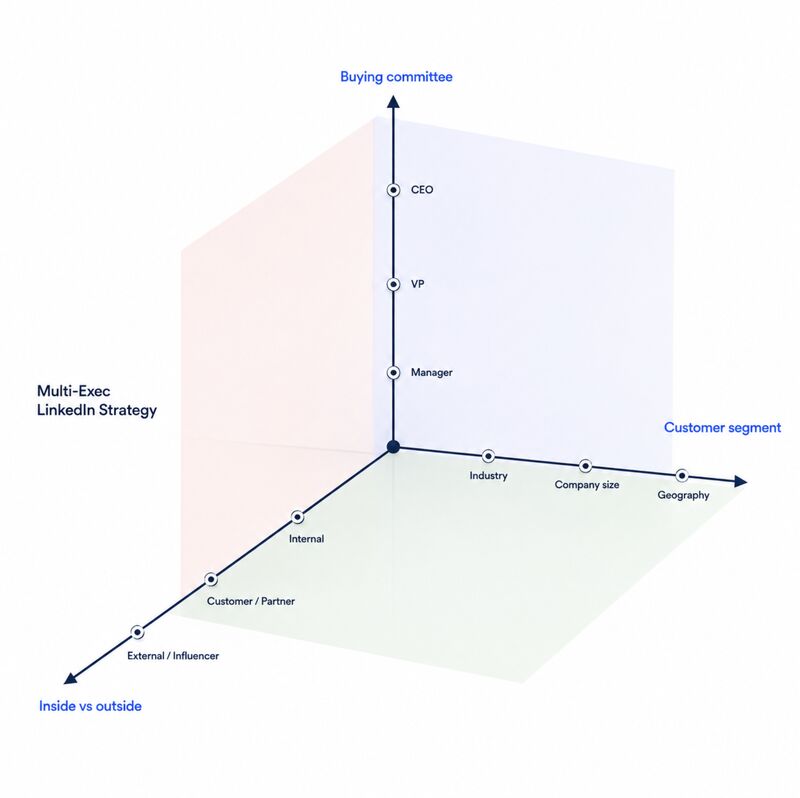
- Use three vectors to map your executive lineup: buying committee, customer segment, and inside vs outside the company.
- Match executives to audiences at roughly the same level: CEOs speak to CEOs, VPs to VPs, managers to managers.
- Segment ownership makes an executive's profile a magnet for a specific customer audience.
- External voices, customers, partners, and investors add credibility and reach that internal executives cannot replicate.
- Multiple voices only work when plugged into a single operating infrastructure: strategy, content, paid, ICP tracking, and sales activation.
The most common mistake I see in executive LinkedIn programs is also the most understandable: the company picks one person, usually the CEO, and asks them to carry the entire channel.
It works for a while. The CEO has the biggest network, the most credibility, and the easiest time getting quoted. But it also creates a ceiling. One voice can only speak to one layer of the market. One profile can only reach one slice of the buying committee. And one person's feed quickly becomes predictable, no matter how good the writing is.
The companies that win on LinkedIn, the ones that make the platform feel inescapable in their category, almost always use multiple executives and outside voices. Not as a stunt. As a system.
This article is the framework I use to design that system. It starts with a simple three-axis chart and ends with a clear operating model for who posts, what they post about, and how the whole thing connects to revenue.
The three vectors
Think of your executive lineup as a set of coordinates in three-dimensional space. Each axis represents a different way your audience can be segmented, and each executive you add should occupy a distinct position.
The three vectors are:
- Buying committee. Which seat on the buying committee does this executive speak to?
- Customer segment. Which customer segment, industry, or use case does this executive own?
- Inside vs outside. Is the voice coming from inside the company, or from a customer, partner, investor, or industry expert?
When you map these three vectors, gaps become obvious. You might have strong coverage at the C-suite but none at the manager level. You might have three executives all talking to the same industry. Or you might have plenty of internal voices and no third-party credibility. The chart makes the imbalance visible before you waste six months producing content into it.
Vector 1: Buying committee
Each major role in the buying committee has different priorities, challenges, and levels of responsibility. Your executive lineup should reflect those differences.
Match executives to the audience at roughly the same level:
- CEOs speak to CEOs.
- VPs speak to VPs.
- Managers speak to managers.
Peer alignment matters because people tend to trust and identify with others who operate at a similar altitude. A VP of Marketing is more likely to take advice from another VP of Marketing than from a CEO who has not run campaigns in a decade. A CFO is more likely to engage with financial reasoning from another CFO than from a founder selling a vision.
The content should also reflect whether the audience is tactical or strategic. Managers usually get more value from practical playbooks, execution guidance, and tools they can use Monday morning. Senior executives are more likely to engage with strategic points of view, market shifts, and business implications.
When you cannot cover the entire buying committee, group roles with similar identities and needs. VPs may identify more closely with the C-suite than managers do, while managers may share similar tactical concerns across functions. The goal is not perfect coverage on day one. The goal is intentional coverage that grows over time.
This is the same fix Vibe.co used to map four executives to four distinct buying-committee seats on the way to a $1.4B acquisition. You can read the full breakdown in how Vibe.co took over LinkedIn.
Vector 2: Customer segment
Different executives can own different customer segments, especially when the product creates distinct value for each one.
This is commonly divided by:
- Industry. A fintech buyer and a healthcare buyer often care about completely different risk, compliance, and workflow questions.
- Company size. What resonates with a 50-person startup rarely resonates with a 10,000-person enterprise, and vice versa.
- Geography. Regional buyers care about local regulations, market maturity, and cultural context.
- Use case. One product can serve multiple jobs-to-be-done, and each use case deserves its own expert voice.
- Customer maturity. A first-time buyer needs education. A sophisticated buyer needs differentiation and proof.
Segment ownership prevents every executive from sounding like a generic company spokesperson. When an executive consistently posts for one segment, their profile becomes a magnet for that audience. Their network fills with the right peers. Their content gets shared in the right Slack channels. And when you later amplify those posts with paid budget, the targeting becomes obvious.
Vector 3: Inside vs outside the company
Internal executives provide company expertise, operating experience, and direct credibility. They know the product, the customers, and the market better than anyone.
But internal voices have limits. They are always read as company voices, no matter how personal the post tries to be. And their networks are usually clustered around their own industry and career history, which may not overlap perfectly with your next wave of customers.
External participants can include customers, partners, advisors, investors, industry experts, and other influential voices. These people expand the range and credibility of the program without requiring every point of view to come directly from the company.
A customer talking about results carries more weight than a vendor making the same claim. An investor explaining why they bet on your category borrows credibility from their portfolio. A partner showing how the integration works reaches an audience that already trusts them.
The best programs mix both. Internal executives establish the core point of view. External voices validate it and extend it into networks the company could never reach on its own.
Assigning roles after the map is built
Once these three vectors are mapped, each participant can be assigned a clear role within the strategy.
Some executives become primary voices. They post regularly, own a specific segment, and represent a consistent point of view. Others become supporting voices. They post around product launches, customer wins, or partner moments. Outside voices become amplifiers, appearing when their credibility matters most.
The role determines the rhythm. A primary voice might post two to four times per week. A supporting voice might post once a week or only around major milestones. An external voice might appear monthly, but each appearance carries disproportionate weight.
The role also determines the content format. A CEO might focus on short strategic essays and company results. A VP might share frameworks and budgets. A customer might share case-study threads. A partner might co-create content about the integration.
Plugging into a single operating infrastructure
Multiple voices only work if they plug into a single operating infrastructure owned by the marketing team. Without that backbone, a multi-executive program becomes a collection of random personal brands that occasionally mention the company.
The infrastructure includes:
- Strategy. The editorial calendar, the message map, and the vector assignments.
- Content production. Interviewing, drafting, editing, and design support for each voice.
- Paid amplification. Thought Leader Ads and boosted posts that put proven content in front of target accounts.
- ICP engagement tracking. Measuring which target accounts and buying-committee roles are engaging, and how often.
- Sales activation. Routing warm engagement to the right reps with the right context.
This system should connect into the broader marketing system as well as sales activation workflows if your company has them. The content team should know which accounts are in active opportunities. The sales team should know which executives a prospect has engaged with. The paid team should know which organic posts are worth amplifying.
This is where most programs break down. They invest in the voices but not the plumbing. They hire ghostwriters but no one tracks whether the right people are reading. They run ads but never feed engagement data back to sales. The strategy looks good on paper and produces nothing in practice.
Common mistakes to avoid
The first mistake is adding executives without a clear vector assignment. If two executives both speak to the same buying committee, the same segment, and both are internal, you do not have a multi-executive strategy. You have redundancy.
The second mistake is treating the CEO as the default answer for every topic. The CEO should own the highest-level strategic narrative, not every product detail, customer story, and partner announcement.
The third mistake is ignoring the network-based reality of LinkedIn. Each executive's content will distribute through their existing network first. If their network does not contain the target audience, even great content will stall. That is why understanding the LinkedIn algorithm matters before you design the lineup.
The fourth mistake is under-investing in the operating infrastructure. Voices are visible. Infrastructure is invisible. But infrastructure is what turns a set of posts into a revenue program.
Start small, then expand
You do not need ten executives on day one. Start with two or three voices that cover distinct coordinates. A CEO for the C-suite and strategic narrative. A VP for the practitioner layer and a specific segment. One external voice for credibility and reach.
Measure whether the right people are engaging, not whether total impressions are climbing. A post with modest reach but high engagement from target accounts is worth more than a viral post that never reaches a buyer.
Once the first few voices are working, add the next coordinate. Fill the gap in the buying committee. Own another segment. Bring in another external partner. The chart becomes a roadmap instead of a one-time exercise.
The one-paragraph version
A multi-executive LinkedIn strategy works when each voice occupies a distinct coordinate across three vectors: buying committee, customer segment, and inside vs outside the company. Map the voices first, assign roles second, and plug everything into a single operating infrastructure owned by marketing. Without the map, you get redundancy. Without the infrastructure, you get noise.
Questions
Frequently asked questions
- What is a multi-executive LinkedIn strategy?
- A multi-executive LinkedIn strategy uses multiple internal and external voices, each mapped to a specific buying-committee role, customer segment, and credibility source, rather than relying on a single executive to carry the entire channel.
- Why shouldn't the CEO handle every post?
- The CEO has credibility at the highest strategic level, but one voice cannot speak credibly to every layer of the buying committee or every customer segment. Peer alignment matters, and managers, VPs, and practitioners often trust voices at their own altitude more.
- How do you decide which executives should post?
- Plot each potential voice on three axes: which buying-committee role they speak to, which customer segment they own, and whether they are internal or external. Choose voices that fill distinct coordinates and avoid redundancy.
- What role do external voices play?
- Customers, partners, investors, and industry experts provide third-party credibility and access to networks the company cannot reach directly. They are most powerful when paired with internal executives who establish the core point of view.
- What infrastructure does a multi-executive program need?
- A shared operating system covering strategy, content production, paid amplification, ICP engagement tracking, and sales activation. Without it, multiple voices become a collection of personal brands rather than a coordinated revenue program.
A weekly newsletter is coming
Garret’s original thinking on attention, credibility and distribution. Email signup is being updated.
About the newsletterWork with us
Ready to dominate LinkedIn?
Influent builds and runs executive LinkedIn programs for category-leading B2B companies.