October 8, 2026 · 11 min read
How does LinkedIn content influence AEO and GEO?
Updated – October 2026
LinkedIn posts and articles can become sources for AI-generated answers. That makes them relevant to answer engine optimization (AEO) and generative engine optimization (GEO), which focus on helping buyers find your expertise through answer-based systems. Publish clear, evidence-backed explanations of buyer decisions, then measure whether AI tools cite them and describe your business accurately.
Garret Caudle, Founder, Influent
Key takeaways
- LinkedIn content can reach buyers through AI answers as well as the feed.
- Publish specific advice about decisions your buyers need to make, supported by evidence your team can share.
- Executives, practitioners, and Company Pages contribute different kinds of useful knowledge.
- Articles should carry complete arguments; supporting posts should offer distinct, standalone insights.
- Measure accurate citations for relevant buyer questions alongside conversations and observable commercial outcomes.
A prospective customer asks an AI tool how to evaluate a problem your company solves. The answer explains the trade-offs, suggests a few approaches, and cites someone who has written clearly about the decision.
That person could be your CEO. It could be the practitioner on your team who knows where implementations fail. It could also be a competitor whose explanation is easier to find.
This is an additional job for executive thought leadership: helping shape the advice buyers receive before they speak to you.
LinkedIn’s 2026 guide to AI search visibility brings together platform data and research from Profound, Meltwater, and Semrush. Its most useful implication for B2B leaders is that public expertise can keep working beyond the feed. An article or post can become source material for an answer delivered somewhere else, to someone who never followed its author.
That changes what deserves space in your content program. Specific explanations, useful decision criteria, and experience your team can substantiate become more valuable. A busy publishing calendar, on its own, gives buyers very little to work with.
How can LinkedIn content appear in AI-generated answers?
Most executive content programs are built around an understandable sequence: publish, reach the right people, earn engagement, and start conversations. AI search adds another possible route. A buyer asks a question; a system retrieves sources; the response borrows an explanation or recommendation from those sources.
The buyer may receive your idea without visiting your profile. They may remember the distinction you made without remembering where it came from. They may also click through to inspect the person behind it. Each is a different outcome, and only the last necessarily produces an observable visit.
In its March 2026 research, Profound ranked LinkedIn first for citations across a defined basket of professional queries tested on six AI-search platforms. That finding covered 1.4 million citations. The professional-query analysis used synthetic prompts; a separate part of the study examined real ChatGPT queries between November 15, 2025, and February 15, 2026.
The opportunity is specific: useful professional advice can travel through these answers. The questions your buyers ask should guide where you investigate first.
For a marketing leader, the practical question is straightforward: when someone asks for advice about the problem you solve, have your people published anything worth using in the answer?
Whose expertise should your company put forward?
The guide cites a striking finding from Meltwater: 75% of LinkedIn citations in its analysis came from individual-member content, compared with 25% from Company Pages. The underlying study analyzed 9.5 million AI citations across six platforms. This is a split within LinkedIn citations, not a claim that individuals receive 75% of all AI citations.
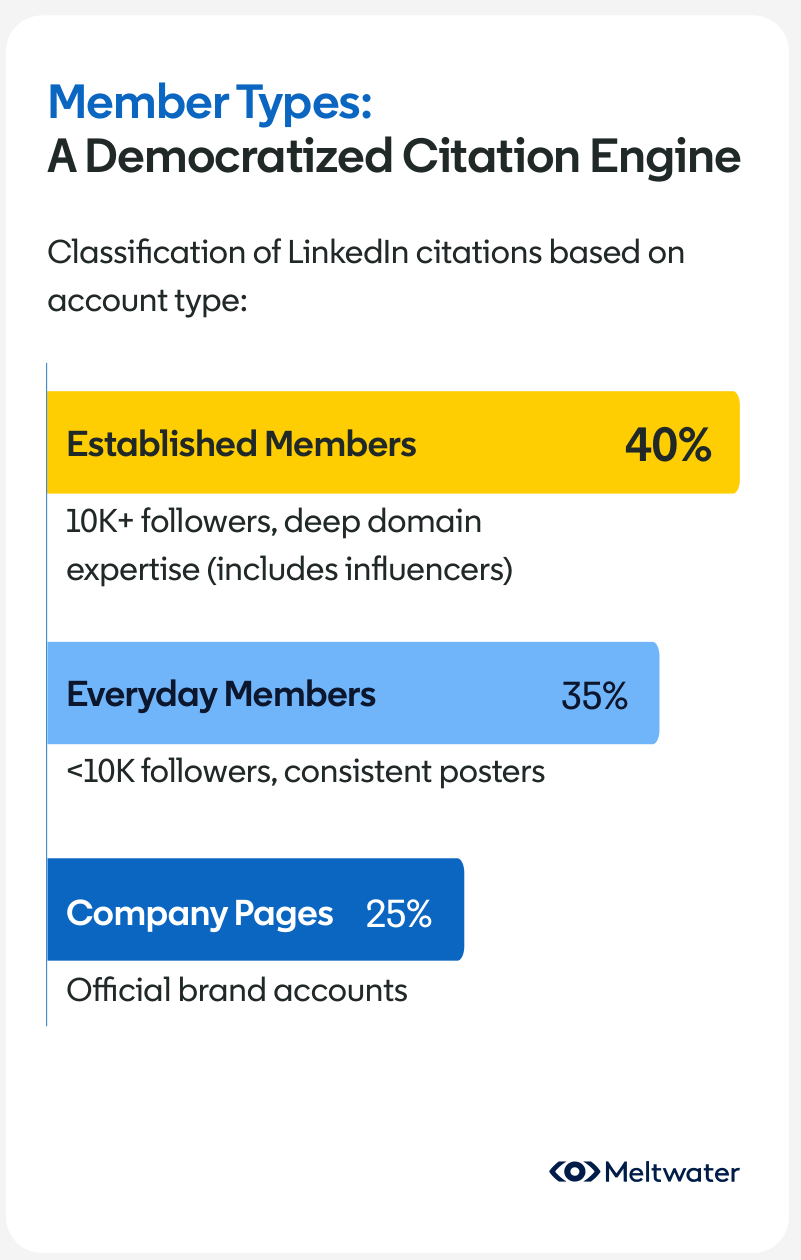
For communications teams, that expands the brief beyond keeping the CEO visible. The person with the most useful answer might lead customer success, run implementation, or spend every week untangling a specific operational problem.
Choose contributors by the questions they can answer with authority:
- The executive can explain the business decision: why it matters, what the company believes, and where leaders misjudge the trade-off.
- The practitioner can explain the work: prerequisites, failure modes, and the difference between a promising demo and a successful deployment.
- The customer-facing expert can explain what buyers repeatedly misunderstand and what changes once a product is in use.
- The Company Page can maintain a clear account of the business, its offering, and the evidence it is authorized to share.
Give these people a common subject and room to contribute different knowledge. Five employees publishing the same approved paragraph add little for a reader. Five useful explanations can answer five different objections.
Company Pages still deserve attention. Semrush’s separate January to February 2026 study found that the member-versus-company mix varied by platform, with Company Pages representing 59% of LinkedIn citations on Perplexity. The lesson is to support the people and maintain the company presence, then inspect what happens in your own category. Source: Semrush.
Publish the decisions buyers need help making
“We need more thought leadership” is too loose a brief to produce useful material. Start with a decision the buyer is struggling to make.
Consider a hypothetical software company selling to revenue teams. “The future of revenue operations” leaves the writer with almost unlimited room for generalities. “When should a revenue team fix its CRM before buying another forecasting tool?” demands a position. It forces the author to name symptoms, explain sequencing, and acknowledge when a new tool will not solve the underlying problem.
The second subject gives the executive something to argue and the buyer something to use.
Build the brief around the author’s recommendation, the evidence behind it, and the conditions that would change it. An approved customer example or a documented implementation lesson gives the argument something concrete to stand on.
This produces a more useful kind of differentiation. A company can claim to be customer-centric in almost any category. An executive explaining exactly which customers should delay a purchase is taking a position a buyer can evaluate.
It also makes interviews more productive. Ask what buyers get wrong, which questions change the recommendation, and what happened the last time the conventional approach failed. Follow up until the answer contains enough detail to survive outside the conversation.
The raw material is often already inside the business. The editorial work is to identify it, verify what can be shared, and make the reasoning clear.
What makes content easier to retrieve and quote?
Good structure helps a reader locate the answer. It also makes an individual section intelligible when it is retrieved or quoted apart from the rest of the article.
On page 20, LinkedIn reproduces Meltwater’s analysis of the 24 most-cited LinkedIn articles: all used lists, 92% used clear section headings, and 67% included hard numbers or data.
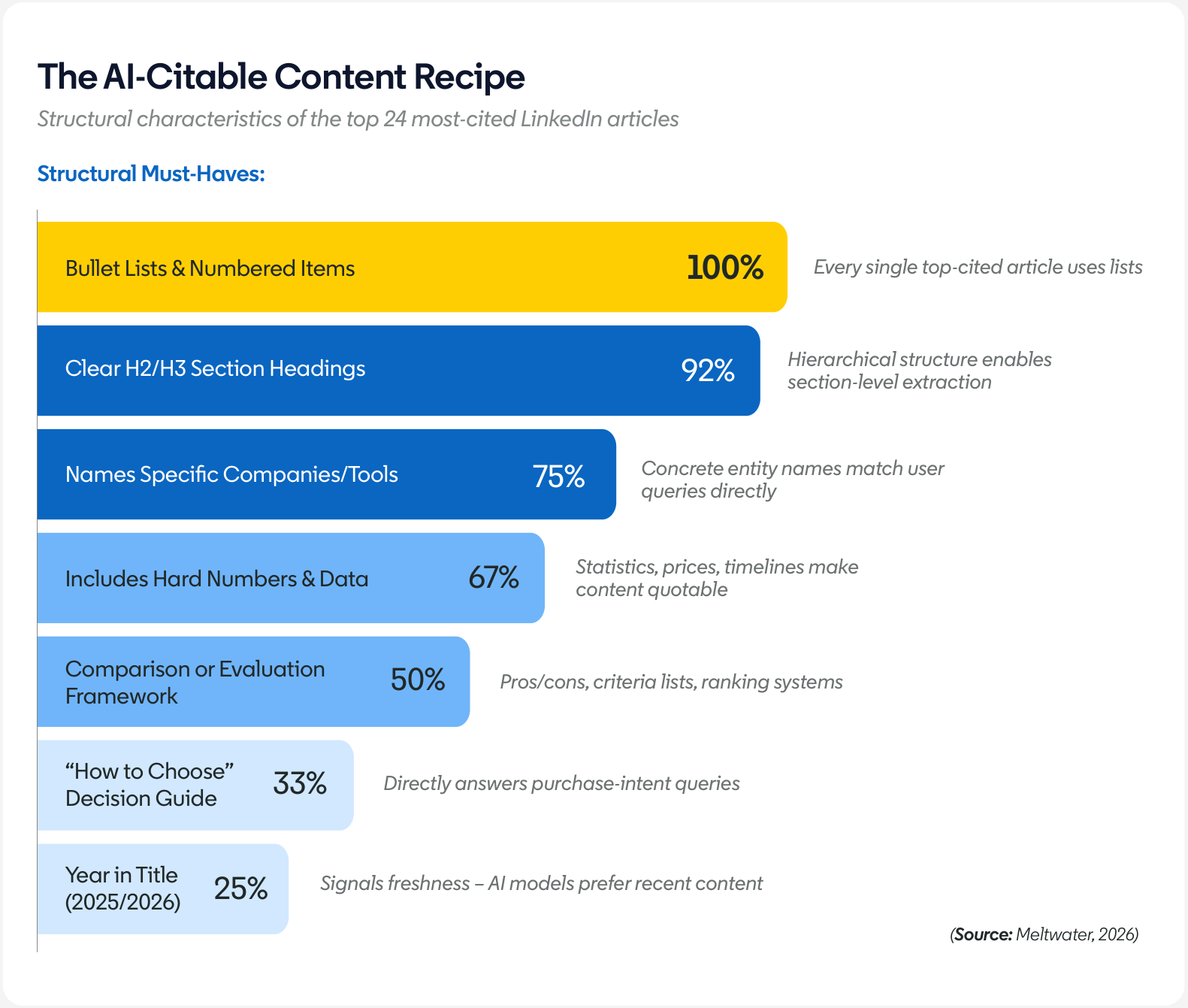
The productive response is better editing. Use a heading that names the question, answer it directly, and then show the reasoning. Keep a statistic’s population and time period close to the number. Explain what a comparison measures. Name the situation in which a recommendation applies.
For example, “Implementation takes six weeks” is easy to repeat and easy to misunderstand. An explanation that identifies the project scope, data-readiness requirements, and work excluded from that estimate is much more useful.
Assume a reader may encounter that paragraph without the introduction. Keep the scope and conditions inside the explanation so the useful advice can travel with its context.
Structure cannot supply an original insight. It can stop a valuable one from getting lost in an opening anecdote, vague terminology, or a paragraph that tries to make four arguments at once.
Should you publish articles, posts, or both?
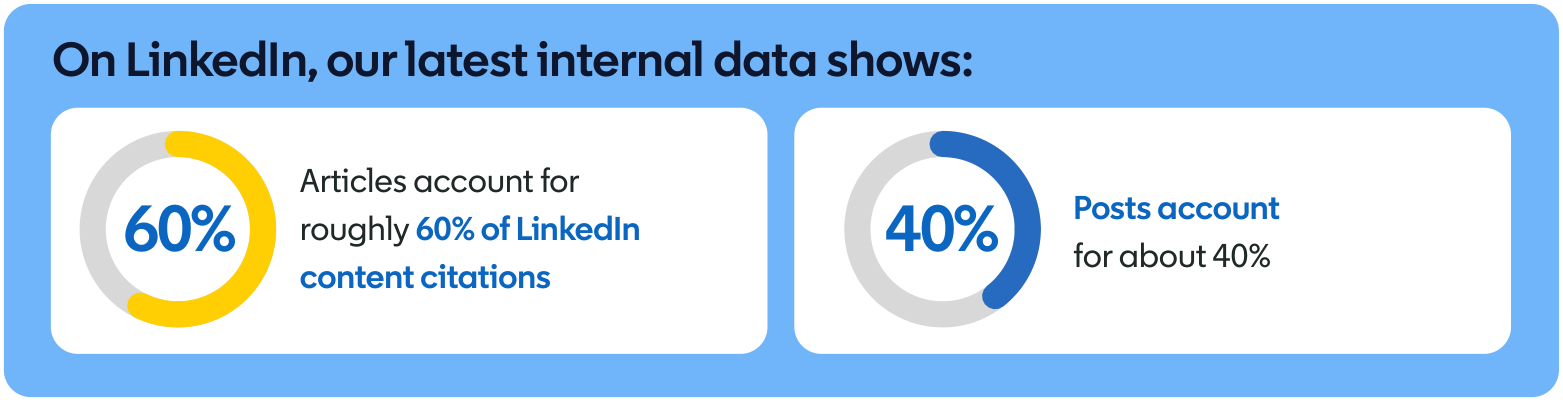
LinkedIn’s guide reports an internal split of roughly 60% of LinkedIn content citations going to articles and 40% to posts. Both formats deserve an editorial role.
Use an article when an idea requires context, a comparison, or a sequence of decisions. Give the reader the complete argument: the problem, the recommendation, the evidence, and the exceptions.
Use a post when one observation can stand on its own. A post might explain a warning sign, challenge a common assumption, or show what changed the executive’s mind. It can point to a longer piece while still rewarding someone who never clicks.
Returning to the hypothetical forecasting example, one article could explain when to repair CRM data before replacing a tool. Supporting posts could cover:
- A diagnostic question that reveals whether forecast inputs are trustworthy.
- A trade-off between implementation speed and data cleanup.
- An objection a finance leader might reasonably raise.
- A situation in which replacing the tool really is the better choice.
Each adds a reason to reconsider the problem. Repeating the article’s introduction four times would waste that opportunity.
Original contributions also stand out in the cited material. Semrush found that approximately 95% of cited LinkedIn posts across its three studied tools were original posts, with reshares making up about 5%. Give the executive a real contribution to make, rather than asking them to circulate the company’s announcement. Source: Semrush, January to February 2026 analysis.
The website should carry the relevant commercial detail and proof; the executive’s article should offer a complete professional perspective. Keep descriptions consistent across both. Buyers who follow the citation should recognize the same business and find evidence that supports the argument.
How do you measure whether it’s working?
A citation is useful evidence of visibility. Its value depends on the question, the claim it supports, and whether the buyer learns something accurate about your business.
An executive can be cited for a generic industry definition without bringing the company into a relevant buying decision. A brand can be mentioned frequently and described incorrectly. Neither problem is visible in a total citation count.
Build a small, repeatable set of buyer questions using sales conversations, customer interviews, and the objections your team hears repeatedly. Include category questions, comparisons, implementation concerns, and situations in which your offering is a poor fit. Record which prompts are branded; asking an AI system about your company by name measures something different from seeing whether it brings you up unprompted.
Then review three kinds of evidence:
1. The right people are responding
Look at who engages with the content and what they say. A detailed question from a relevant buyer can inform the next article. Reach and reactions help explain distribution, but neither establishes that an AI system has cited the work.
2. Your expertise is appearing accurately
Record the exact answer, cited URL, platform, prompt, and date. Separate a brand mention from a linked citation. Note whether your source provides the central recommendation, supporting evidence, or a passing reference. Inspect the description itself: does it preserve the recommendation and its limits?
Keep the tracked question set reasonably stable so comparisons mean something. If you expand it, show the original group separately. Repeated observations are more informative than a screenshot of one favorable answer.
3. Visibility is connecting to commercial behavior
Track identifiable referral visits, relevant inquiries, and opportunities where the content enters a sales conversation. Ask prospects how they researched the problem. Record those answers separately from what analytics can directly observe.
If citations rise while relevant conversations do not, examine which questions are producing the visibility and what readers encounter next. You may be reaching a broad research audience, answering the wrong question, or sending interested buyers to a page that does not support the argument.
LinkedIn recommends allowing at least 30 days before evaluating AI-visibility impact and continuing to measure beyond that point. Use monthly reviews to compare patterns across questions, authors, and formats. Source: LinkedIn guide, pp. 27-34.
Start with one question your team can answer better
You do not need to turn every executive into a full-time publisher to test this.
Choose one commercially important question, one executive with a defensible view, and one practitioner who can supply detail. Establish what AI answers currently say about the topic. Interview the contributors, verify the evidence, and publish a complete article with a few distinct supporting posts.
Give one editor responsibility for the argument and the sources. Involve the person who owns search measurement and the people who hear buyer objections. Keep review focused on factual accuracy, disclosure, and genuine disagreement rather than sanding the writing into a committee-approved generality.
Plan to maintain what you publish. The guide’s Meltwater chart shows that 48% of cited content was less than three months old. Review a useful existing article when the advice, evidence, or market changes. An updated explanation of a consequential decision can contribute more than another post introducing the same broad theme.
At Influent, we see this as a reason to take the substance of executive thought leadership more seriously. Buyers need informed judgment. Publishing that judgment clearly gives it more opportunities to be discovered, discussed, and used.
Your executive’s most valuable contribution may be the explanation a prospective customer needed before they knew which company to call.
What should your executives be known for?
Build your LinkedIn thought leadership around the questions your buyers need answered and the expertise your team can genuinely contribute.
Sources and research notes
This article is Influent’s interpretation of LinkedIn’s *Unlocking AI Search Visibility: The B2B Marketer’s Guide to LinkedIn* (2026), especially pages 9, 18, 20, and 27-34. The report combines LinkedIn internal observations and external studies; it is not a single controlled experiment. Chart excerpts retain their original labels and attribution.
- Profound, March 9, 2026: professional-query citation analysis across six platforms, with separate methodology for real ChatGPT usage.
- Meltwater, May 12, 2026: 9.5 million citations across six platforms; member/company mix and a 24-article structural analysis.
- Semrush, March 10, 2026: 325,000 unique prompts and 89,000 unique cited LinkedIn URLs across three tools, studied in January to February 2026.
The studies use different prompt sets, dates, and definitions. Their percentages should not be combined into a single benchmark. The publishing and measurement recommendations above are editorial judgments; they do not guarantee rankings, citations, or revenue.
Questions
Frequently asked questions
- How does LinkedIn content influence AEO and GEO?
- LinkedIn posts and articles can become sources for AI-generated answers. That makes them relevant to answer engine optimization (AEO) and generative engine optimization (GEO), which focus on helping buyers find your expertise through answer-based systems. Publish clear, evidence-backed explanations of buyer decisions, then measure whether AI tools cite them and describe your business accurately.
- Should executives prioritize articles or short posts for AI visibility?
- Give them complementary roles. Articles can explain a decision in depth; posts can make one useful observation or answer one narrower question. LinkedIn reports a 60% article and 40% post citation split in its internal data, but that is not a universal performance benchmark.
- How should a B2B team measure LinkedIn’s contribution to AI search?
- Track a stable set of relevant buyer questions, record which sources are cited, inspect how the company and its experts are described, and compare results across platforms over time. Review referral visits and qualified conversations separately from citation counts.
A weekly newsletter is coming
Garret’s original thinking on attention, credibility and distribution. Email signup is being updated.
About the newsletterWork with us
Ready to dominate LinkedIn?
Influent builds and runs executive LinkedIn programs for category-leading B2B companies.