August 14, 2026 · 7 min read
Content-market fit: the framework behind every post worth publishing
Content-market fit is the overlap between what an executive can speak to with depth, what the ICP actually cares about, and what points back to a commercial problem. Here is how we validate it.
Garret Caudle, Founder, Influent
Short answer
Content-market fit is the overlap between what an executive can speak to with real depth, what the ICP actually cares about, and what points back to a commercial problem you solve. Without all three, consistent posting still produces nothing.
Key takeaways
- Content-market fit is the overlap of exec POV density, ICP emotional relevance, and commercial relevance.
- The most common mistake is anchoring content in your service or industry instead of the buyer's real concerns.
- ICP emotional relevance is the gatekeeper: if the buyer does not think about the topic unprompted, it is out of bounds.
- Only topics that pass all three checks get published. Everything else is vendor content, thin thought leadership, or personal brand.
- Re-run the checks per executive, because different leaders in the same company sit in different arenas.
Content-market fit is the overlap between three things: what an executive can discuss with real depth, what their ICP actually cares about, and what eventually points back to a commercial problem the company solves.
If any one of the three is missing, the content either gets ignored, gets vanity engagement from the wrong people, or gets attention that never turns into pipeline.
The core principle is easy to miss: content-market fit is not about what the exec knows. It is about where the exec's knowledge overlaps with what the ICP already cares about. The expertise is real. It is just often sitting in the wrong arena.
The three ingredients
- Exec POV density. Specific stories, mistakes, tradeoffs, unpopular opinions, and patterns from an actual career. Not opinions collected from other people's posts.
- ICP emotional relevance. Something the buyer thinks about unprompted during a normal week. Does it touch their money, power, status, stress, or time?
- Commercial relevance. A connective thread back to the problem the company solves. It does not need to be a pitch. It needs to exist.
The most common mistake
Most executives anchor their content in their service or their industry instead of in the buyer's real concerns.
- Accounting CEOs talk about accounting.
- Restoration CEOs talk about water damage.
- IT founders talk about servers and security stacks.
In the ICP's head, those topics are background noise. Vendor stuff. Not core to how they think about their own job. The expertise is genuine, but it lives in an arena the buyer never walks into.
This is the failure a good program is hired to fix. If a company could reliably identify its own content territory, it would not need help publishing in it.
How to validate a content pillar
Before approving any pillar or topic for an executive, run three checks.
Check 1: exec POV density
Can this executive tell specific stories, name real mistakes, describe tradeoffs they lived through, and hold an unpopular opinion on this topic? If they can only speak in generalities, the content will read thin no matter how well it is written.
Check 2: ICP emotional relevance
Does the ICP think about this unprompted during a normal week? Does it affect their money, power, status, stress, or time? This is the check that kills the most topics. An exec can be a world-class expert on something their buyer simply does not care about.
Check 3: commercial relevance
Can this topic, even loosely, be linked back to the problem the company solves? It does not need to be a direct pitch. It needs a connective thread.
The hard rule. If Check 2 is a no, the topic is out of bounds, even if the executive is the most qualified person alive on the subject. ICP emotional relevance is the gatekeeper. Everything else is negotiable.
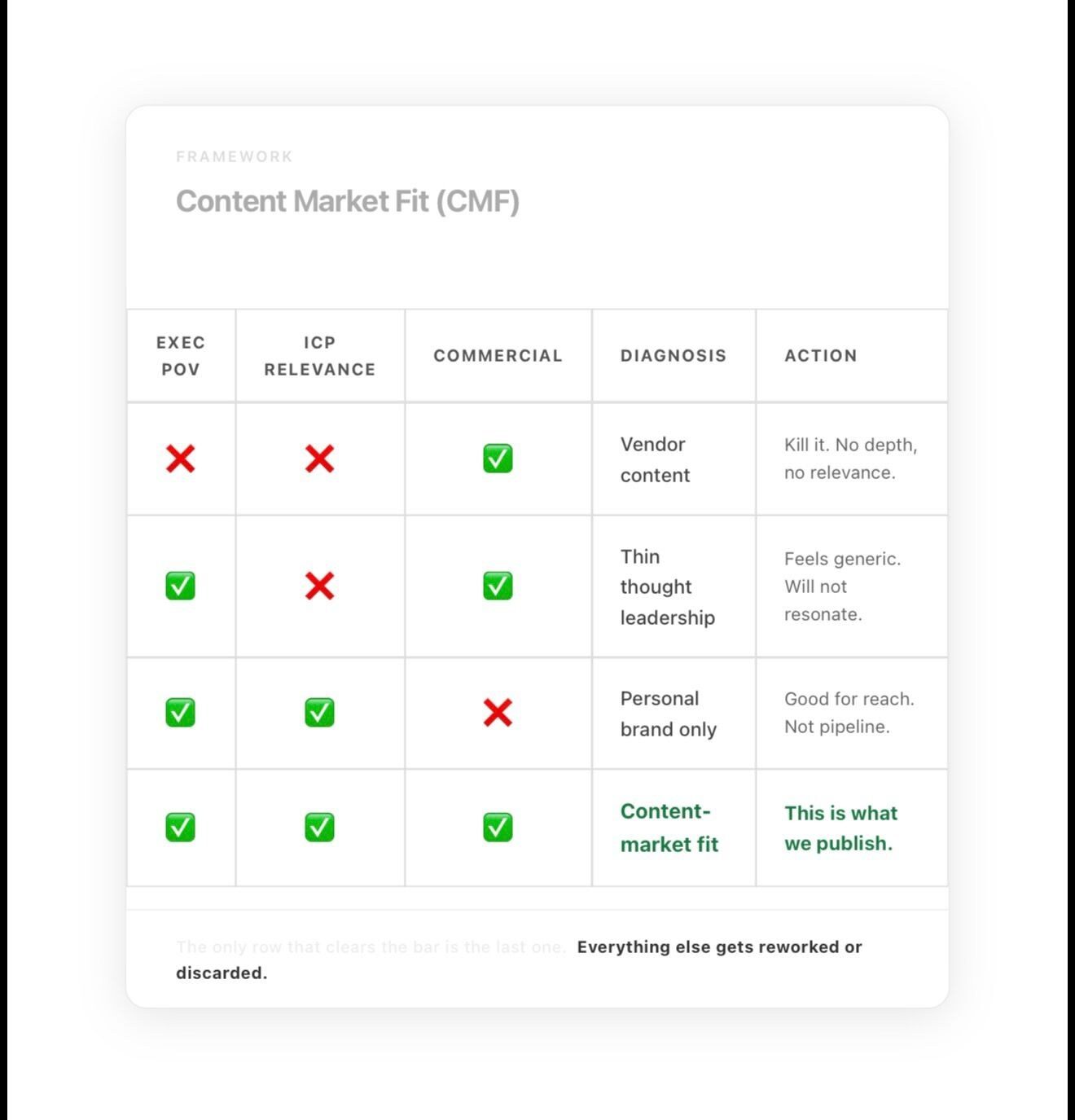
The decision matrix
| Exec POV | ICP relevance | Commercial | Diagnosis | Action |
|---|---|---|---|---|
| No | No | Yes | Vendor content | Kill it. No depth, no relevance. |
| Yes | No | Yes | Thin thought leadership | Feels generic. Will not resonate. |
| Yes | Yes | No | Personal brand only | Good for reach. Not pipeline. |
| Yes | Yes | Yes | Content-market fit | This is what we publish. |
Only the last row clears the bar. Everything else gets reworked or discarded.
Three executives, three arenas
The pattern below is always the same: move out of the exec's service language and into the ICP's emotional language. These executives are invented, but the topics are the ones we see every week.

Fictional example
Dana Whitfield
CEO, mid-market accounting firm
ICP: Business owners, founders, finance leaders
Out of bounds
- 3 ways to improve your chart of accounts
- How to structure your debits and credits
- Bookkeeping hacks in QuickBooks
Content-market fit
- The real reason founders feel profitable but broke
- How messy numbers quietly kill negotiation leverage when you go to sell
- The 3 finance blind spots that almost always stall growth after $5M
Money, risk, control, growth. Her ICP wants the accounting problem handled, not explained.

Fictional example
Marcus Vela
CEO, emergency restoration company
ICP: Property owners, asset managers, facility leaders, insurers
Out of bounds
- How to dry out a flooded basement
- Why our drying equipment is more advanced
- Understanding category 3 water
Content-market fit
- Most businesses are one bad night away from a six-figure loss and have no idea
- The 4 ways vendors quietly pile on cost when you are already in crisis
- How a broken chain of command turns a $20K problem into $200K
Fragility, risk, and operational pain. Nobody thinks about drying equipment until the water is already in the building.

Fictional example
Arjun Raman
Founder, IT and cybersecurity firm
ICP: CEOs, COOs, CIOs, heads of ops
Out of bounds
- Zero trust architecture explained
- Best practices for endpoint protection
- Why you need multi-factor authentication
Content-market fit
- How a single bad access decision turned into a seven-figure outage
- Why internal politics around security do more damage than hackers
- The real cost of pretending your stack is safer than it is
Business continuity, reputational damage, hidden fragility. Not a vendor education session.
Notice what did not change in any of those examples. The expertise is identical on both sides of each card. The accountant still knows accounting, the restoration CEO still knows drying equipment, the founder still knows zero trust. What changed is the arena the knowledge is spoken into.
Turning fit into posts
Once a pillar clears all three checks, the topic is only half the work. The opening line still has to name the audience and name something they care about, which is the job of the hook. Content-market fit decides what to write about. The hook decides whether the right person reads it.
Service-linked posts are the easiest way to keep commercial relevance alive without pitching. Two examples from the accounting arena:
- "We just helped a client clean up 18 months of bad bookkeeping so they could close a round. Here is what was actually broken."
- "A founder thought they had 12 months of runway. The real number was 6. Here is how we surfaced it."
Both are stories about the buyer's stakes, told from inside the work. That is what content-market fit sounds like in practice.
Where programs lose it
Content-market fit is not a one-time decision. Programs drift back toward vendor language over time, usually because service topics are easier to produce and get polite engagement from peers and competitors. The McDonald's example shows the other failure mode: content with reach and no fit between the executive's authority and what the audience was ready to hear from them.
Re-run the three checks quarterly, and re-run them per executive when multiple leaders post. Different executives sit in different arenas even inside the same company, and a pillar that fits the CEO can be completely out of bounds for the CTO.
Questions
Frequently asked questions
- What is content-market fit?
- Content-market fit is the overlap between what an executive can speak to with real depth, what their ICP emotionally cares about, and what connects back to a commercial problem the company solves. Content that misses any of the three gets ignored, attracts the wrong audience, or fails to produce pipeline.
- How do you test whether a content pillar has content-market fit?
- Run three checks. Can the exec tell specific stories, mistakes, and tradeoffs on this topic? Does the ICP think about it unprompted in a normal week and does it touch their money, power, status, stress, or time? Can it be linked, even loosely, to the problem the company solves?
- Why is ICP emotional relevance the deciding factor?
- Because expertise the buyer does not care about is invisible. If a topic fails the ICP relevance check, it is out of bounds even when the executive is a world-class authority on it. Exec depth and commercial relevance are negotiable in degree; buyer relevance is not.
- What does content without content-market fit look like?
- Vendor content when there is no exec depth and no buyer relevance, thin thought leadership when the exec has depth but the buyer does not care, and personal brand content when the exec and audience are aligned but nothing connects to a commercial problem.
- Does content-market fit differ by executive within one company?
- Yes. Each executive has a different arena of lived experience and often addresses a different member of the buying group, so pillars should be validated per executive rather than once at the company level.
A weekly newsletter is coming
Garret’s original thinking on attention, credibility and distribution. Email signup is being updated.
About the newsletterWork with us
Ready to dominate LinkedIn?
Influent builds and runs executive LinkedIn programs for category-leading B2B companies.