
Case study · Life Science Connect
How Life Science Connect got its editors posting on LinkedIn.
A four-week employee advocacy pilot across three brands: the problem, what we built, and what it produced. April to August 2026.
 Jim PomagerVP, Community Success
 Matt PillarVP, Editorial and Content

The opportunity
The editors already had the audience
LSC's editors are known by name to the people sponsors pay to reach, and most of them have more followers than the brand pages they write for. Nobody had asked them to post as themselves.
 Erin HarrisChief Editor, Cell & Gene · 21,300 connections
 Jon O’ConnellExecutive Editor, Cell & Gene · 3,700 connections
 Louis GarguiloChief Editor, Outsourced Pharma · 14,800 connections
 Jeffrey BuguliskisDeputy Chief Editor, Outsourced Pharma · 4,300 connections
 Anna Rose WelchEditorial Director, Advancing RNA · 9,800 connections
 Michael SolowayAcquisition Editor, Advancing RNA · 3,000 connections
The bet: LinkedIn gives people more reach than company pages. If the editors wrote posts with strong hooks, they would reach more of the right people than the pages ever had. So the pilot put the editors in front and the pages behind them.
Three of 15 brands were chosen for the pilot: Cell & Gene, Outsourced Pharma and Advancing RNA. Connection counts from LinkedIn, November 2026.
Why it worked
The hook made the difference
Two posts by the same editor, one day apart. The only difference is the hook. Across all 80 editor posts, hooks that challenged what the reader believed earned 5.5 ICP engagements per post. Hooks that described the topic earned 0.8, at the same reach.
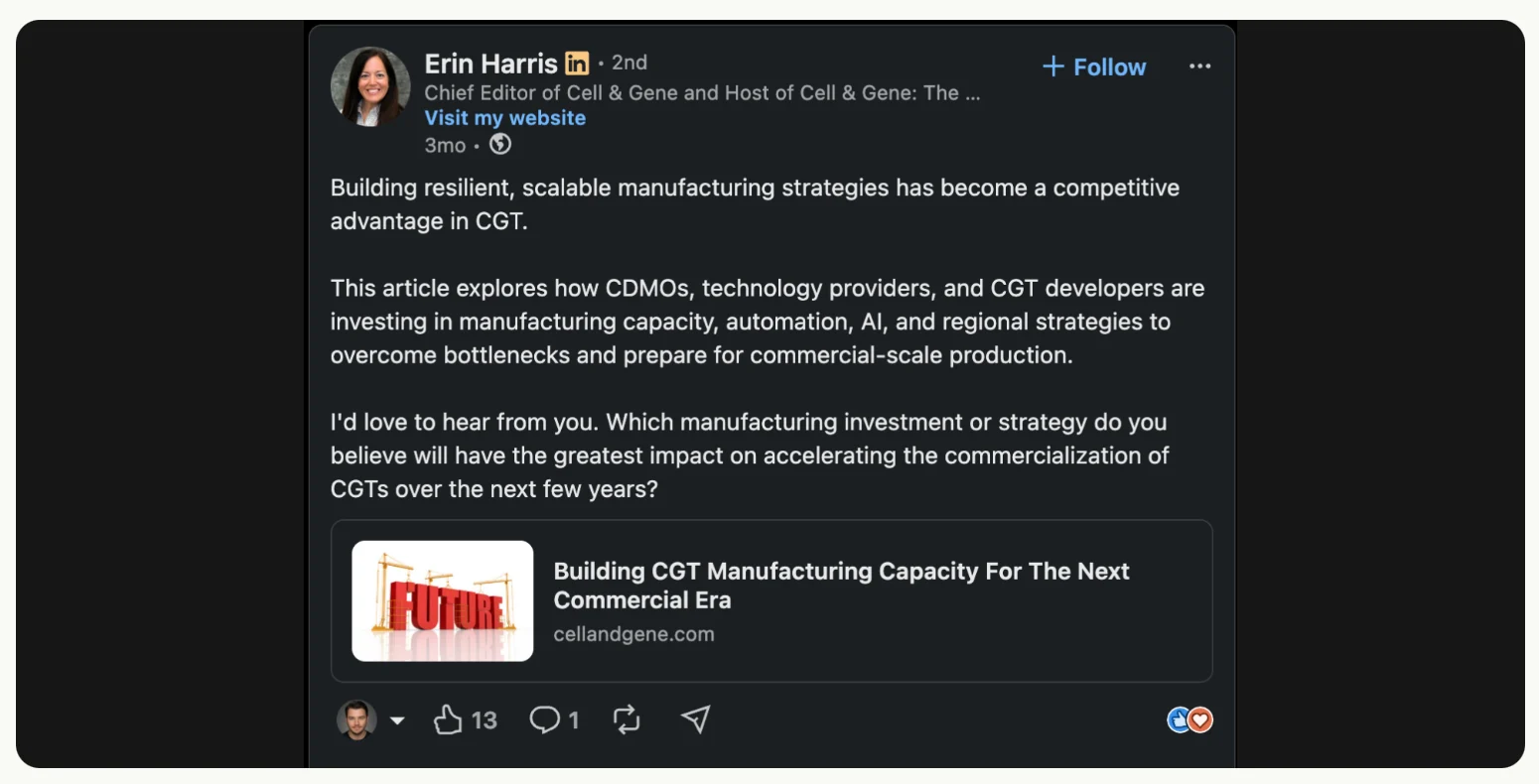
- 931
- impressions
- 1
- ICP engagement
- July 13
- hook describes the topic
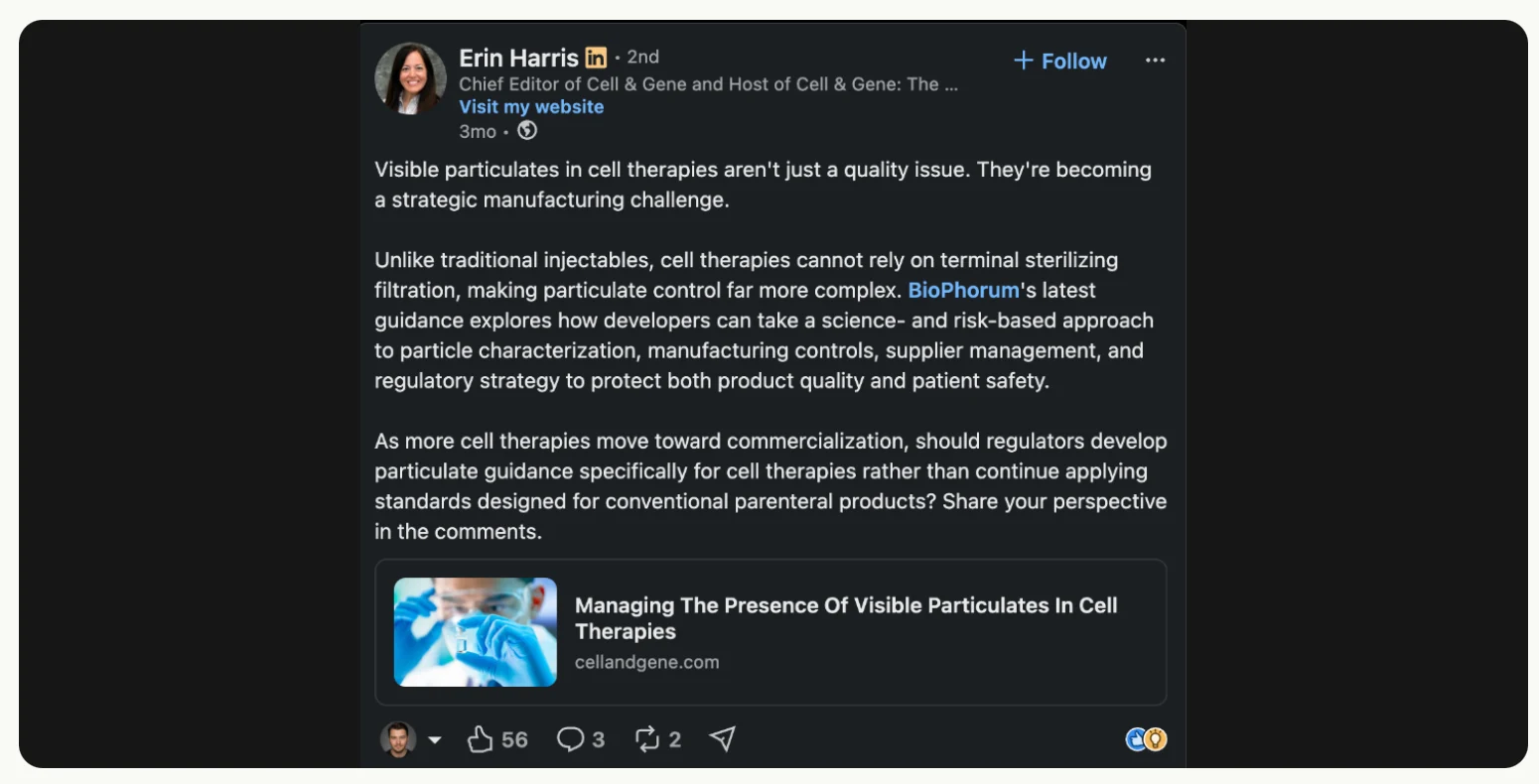
- 5,568
- impressions
- 25
- ICP engagements
- July 14
- hook challenges a belief
Screenshots from LinkedIn. Both posts linked to a Cell & Gene article.
Why it worked
Every editor had a post that worked
The eight best posts came from four editors across all three brands.
- Erin Harris · Cell & GeneWrote the best post of the pilot: 5,568 impressions and 25 ICP engagements.
- Jon O’Connell · Cell & GeneMost commented post of the pilot, and the most repeat engagement from the same people.
- Louis Garguilo · Outsourced PharmaHighest reach of any editor, and the most forwarded post of the pilot with 18 sends.
- Jeffrey Buguliskis · Outsourced PharmaSmallest audience, best fit. Everyone in the ICP who engaged with him was a director or above.
- Anna Rose Welch · Advancing RNAThe most consistent editor. Her typical post earned three ICP engagements.
- Michael Soloway · Advancing RNAThe most saved post of the pilot, with 8 saves and 13 ICP engagements.
Advancing RNA was the most efficient brand: 52 companies reached from 30 editor posts.
Source: Influent's pilot analysis. Headshots from LinkedIn.
What the client said
What LSC's leadership said
“Our referral traffic from LinkedIn to the website was easily double, maybe triple, for the month.”
Matt PillarVP, Editorial and Content“The biggest takeaway for the editors was: wow, if Erin can do that, if we spend a few more minutes on our posts, I think we can make some measurable progress.”
Matt PillarVP, Editorial and Content“There was a material improvement in follower and connection growth among the pilot editors, even those who aren’t running automated connection campaigns. That was really good to see.”
Matt PillarVP, Editorial and ContentPhase 4 final readout, August 6, 2026. Quotes lightly trimmed for the slide.
The results
The people who engaged
Manufacturing, quality and regulatory leaders at the companies LSC's sponsors sell to.
People in the ICP who engaged
 Stephan Krause, PhDExecutive Director, Cell Therapy Quality, Bristol Myers Squibb
 Marianna SabatinoVP Process Sciences, Analytics and Technology, AstraZeneca
 Benjamin StevensSenior Director, Regulatory Affairs CMC Policy, Alnylam
 Bita BadieiExecutive Director, CMC Regulatory Affairs, Kite Pharma
 Zoe ZhengExecutive Director, Pipeline CMC Technical and Strategic Lead, Legend Biotech
 John BowenSenior Director, Mixed Modality Operations, Eli Lilly
 Samir PanjwaniAssociate Director, External Manufacturing, Cell Therapy, AstraZeneca
Where the 174 people work
- Thermo Fisher Scientific
- AstraZeneca
- Sanofi
- Bristol Myers Squibb
- Eli Lilly
- Legend Biotech
- Kite Pharma
- Biogen
- Astellas Gene Therapies
- AbbVie
- Alnylam
- Lonza
- Genentech
- Novartis
- Pfizer
- Johnson & Johnson
- GSK
- Amgen
- Takeda
- Catalent
- Arcellx
- Cartesian Therapeutics
- Codexis
- Aspen Neuroscience
- Alliance for mRNA Medicines
Source: Fluentcy, posts published June 29 to July 26, 2026. Titles from LinkedIn.
Post example 1 · A question people disagree about
The most commented post of the pilot
Jon O’ConnellExecutive Editor, Cell & Gene · July 21, 2026In week two we asked editors to end posts with a question. Seven tried it and six got no replies. This one got six comments because the question is about something the industry is actually arguing over: whether editing reagents should be classified as drug substance. The head of a cell therapy program pushed back in the thread and another editor answered him.
Comments on editor posts doubled from the first two weeks to the last two, from 17 to 34.
- 6
- comments
- 2,242
- impressions
- 2.36
- engagements per person on Jon's posts, the most of any editor
- 2x
- comments on editor posts in weeks 3 and 4
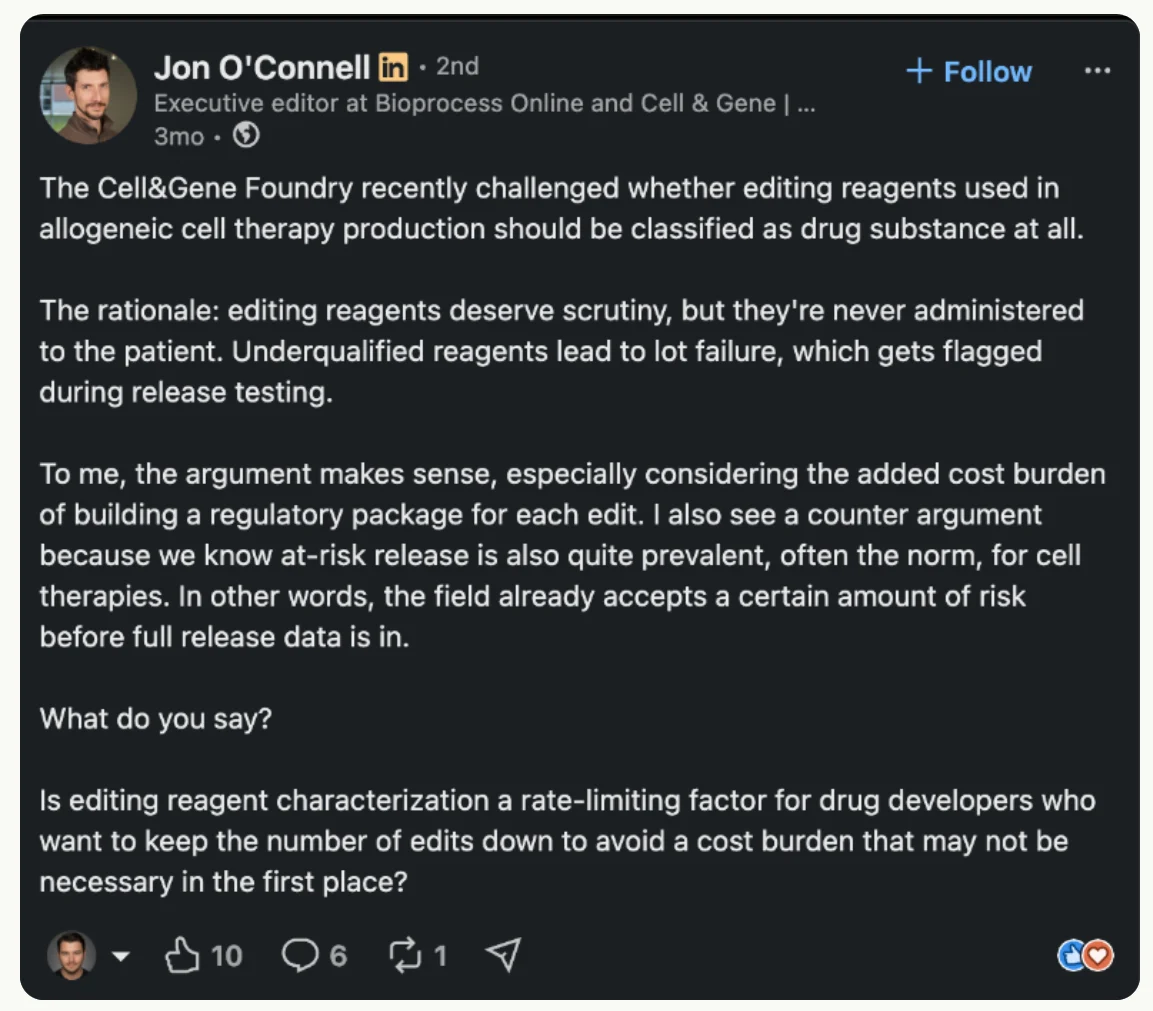
Screenshot from LinkedIn. Metrics from Influent's pilot analysis.
Post example 2 · An unexpected way into a technical subject
The best ratio of ICP engagement to impressions
Jeffrey BuguliskisDeputy Chief Editor, Outsourced Pharma · July 1, 2026This post shares a contributor’s article, but the hook is the contributor’s background: he built six Orangetheory franchises before moving into supplier management for cell therapy. The reader cannot guess where it is going, and the person turns out to be an expert.
Everyone in the ICP who engaged with Jeffrey during the pilot was a director or above. The format is easy to repeat. Every editor knows people who took an unusual route into the industry.
- 10.2
- ICP engagements per 1,000 impressions
- 293
- impressions
- 3
- ICP engagements
- 100%
- of the ICP who engaged were director or above
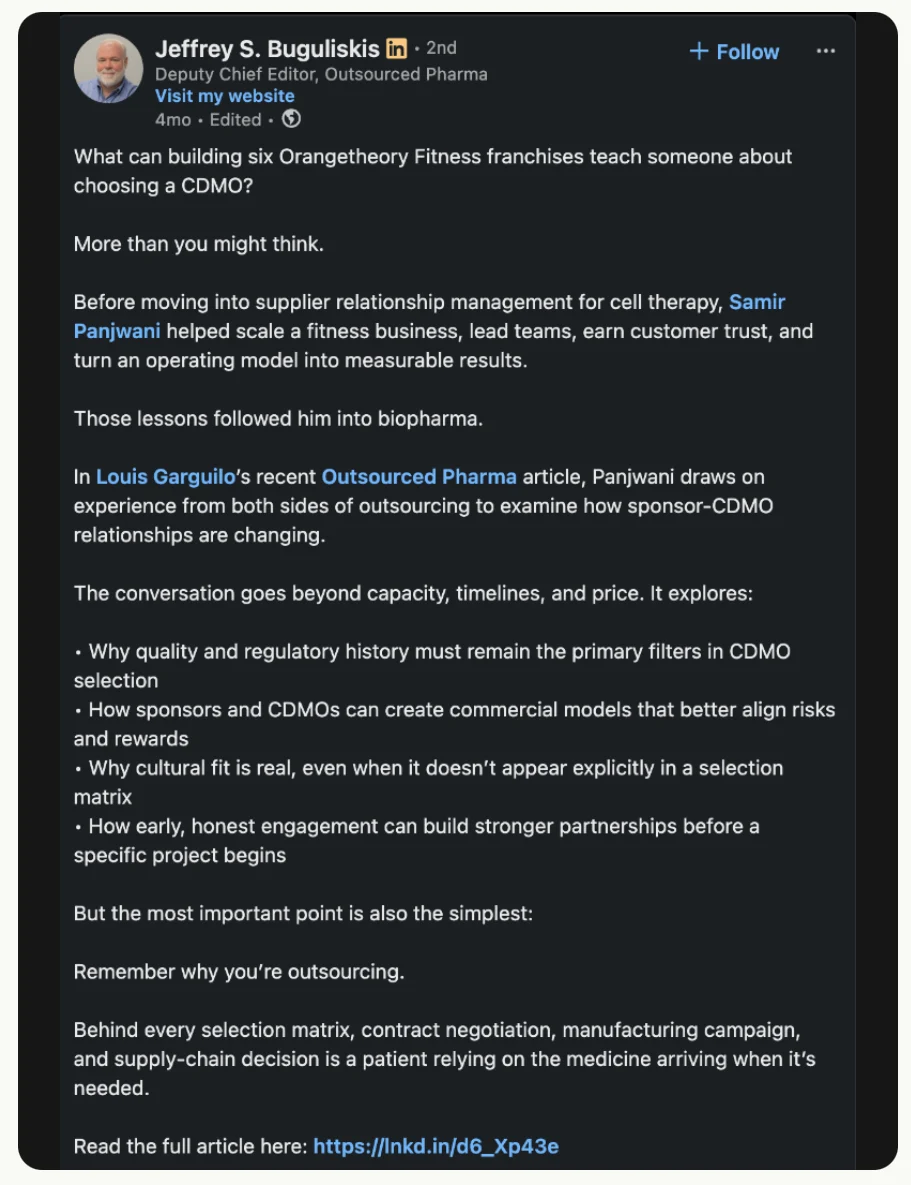
Screenshot from LinkedIn. Metrics from Influent's pilot analysis.
Post example 3 · Technical depth with a point of view
The most saved post of the pilot
Michael SolowayAcquisition Editor, Advancing RNA · July 13, 2026This post shares a contributor article, but the hook is the article’s argument: the purification method matters less than understanding how the molecule behaves. Eight people saved it to come back to, and the article’s authors added to the thread.
Advancing RNA reached 52 companies in four weeks, the most of the three brands.
- 13
- ICP engagements
- 3,367
- impressions
- 8
- saves
- 36
- reactions
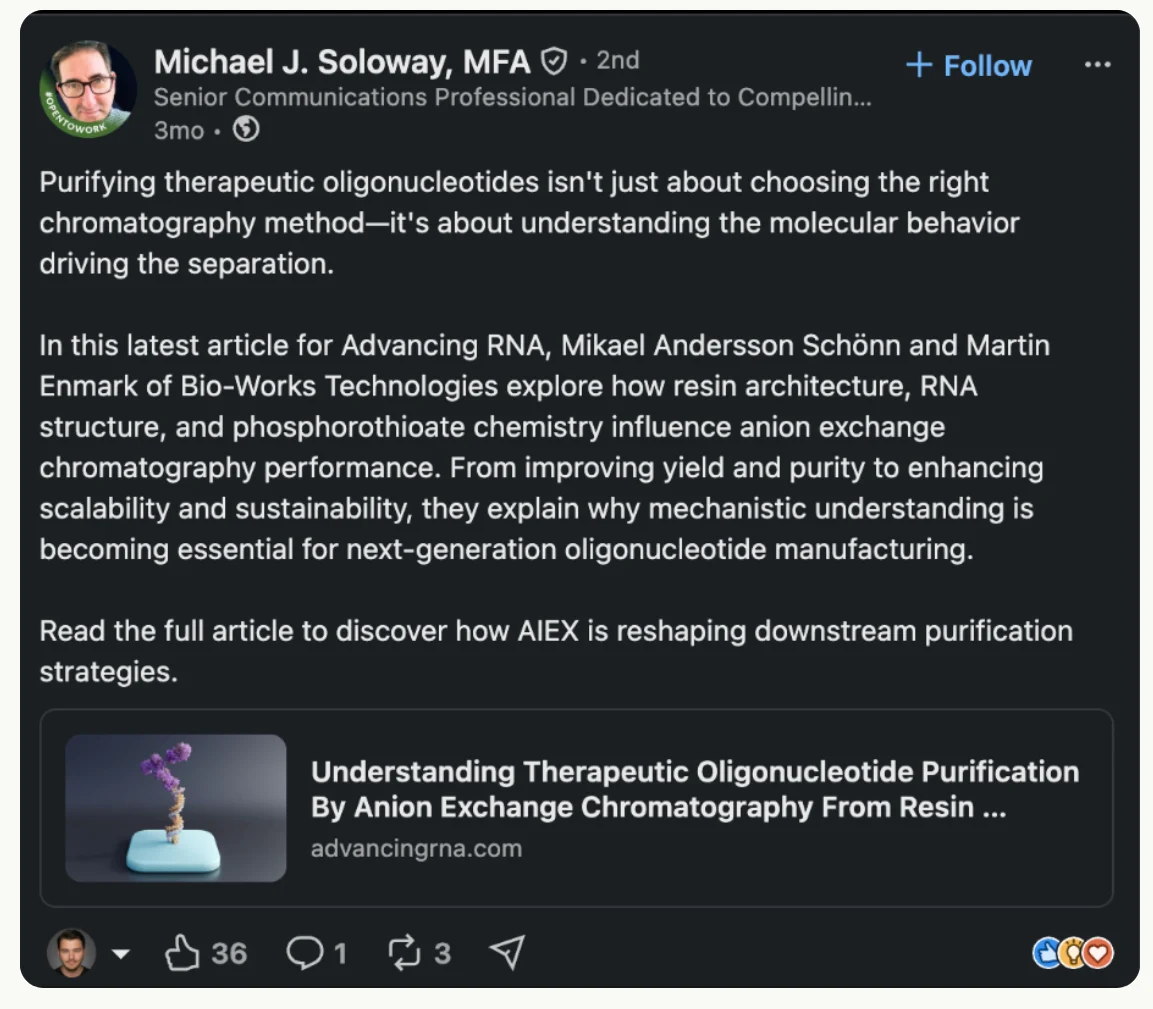
Screenshot from LinkedIn. Metrics from Influent's pilot analysis.